Discord Analytics That Improve Onboarding, Engagement, and Chat Quality (KPIs + Server Insights)
Summary
Turn Discord metrics into action. Learn onboarding + engagement KPIs (verification rate, 5-minute retention, conversation depth) and how Server Insights fits in.
Most community leaders don’t need “more dashboards.” They need Discord analytics that point to what to change next—so onboarding improves, early engagement rises, and conversations stay high quality.
In this guide, you’ll learn how to use Discord’s available analytics (especially Server Insights) alongside action-oriented KPIs built around the member journey: onboarding → early chatting → return behavior → conversation depth.
What Discord Analytics Can (and Can’t) Tell You
Discord analytics should not be treated like “doom data” that you can’t affect. Instead, use it to understand what’s happening structurally in your community and where the member journey breaks.
Discord Server Insights is the main built-in place to look at server-level trends like:
- Traffic and where it comes from (e.g., invite/referral sources)
- Announcement performance
- High-level location/demographics
However, Server Insights data can be incomplete or lag. For example, referral domain details may not be fully present. Treat Server Insights as guidance, not absolute truth—especially when decisions depend on precise attribution.
Action-Driven Analytics: Track Onboarding and Engagement Stages
A key idea is “action-driven analytics”: rather than measuring vanity metrics, track whether members complete the actions your community needs.
Instead of only asking “How many joined?”, focus on technical and behavioral onboarding stages:
1. Can users find and click your Discord invite link?
2. Can they complete verification?
3. Can they pass the welcome flow?
4. Do they know what to do next?
Then measure engagement in stages after joining:
- After users send their first message
- After users chat for five minutes
- After users return later (the transcript frames this as assessing return behavior using time windows such as seven days)
This approach helps you pinpoint where improvement will matter most—invite discoverability, verification friction, welcome flow clarity, or early interaction quality.
Action-Oriented KPIs: Moderator Performance and Chat Quality
To improve community outcomes, the transcript emphasizes KPIs tied to behavior and moderation impact.
Moderator performance as a driver
In smaller servers especially, moderators can have an outsized effect because new members often rely on guidance and greetings to know how to participate.
An action-oriented KPI here is how many people moderators effectively “talk to or greet,” because moderator responsiveness can shape whether newcomers begin real conversations.
“Chat quality” as a moderation metric
The session also highlights “chat quality” as an action-driven metric—something moderation influences directly.
A practical takeaway: moderators should talk “like a human.” When moderation sets the tone and models how members should communicate, discussion quality tends to improve.
Server Insights for Traffic, Announcements, and Demographics
Server Insights can help you understand how new members find you and how your announcements perform.
Make announcements matter
A specific takeaway from the session: making your announcement channel strong can drive roughly 4× more traffic in the announcement channel than other channels.
So if your announcements aren’t converting, don’t guess—use Server Insights to check whether improvements to your announcement channel correlate with higher traffic.
Use traffic source data carefully
Server Insights may show where traffic comes from, but referral domain data can be incomplete. Traffic source data may also be partial and lag, mixing sources like search engines and platforms.
Use it to direct investigation (e.g., “where are new visitors likely coming from?”) rather than treating it as perfect attribution.
Use location/demographics for channel strategy
Server Insights can show when certain countries represent meaningful portions of your community. The transcript suggests that when a location is around ~5–10%, it can justify actions like adding language-specific channels.
Verification Rate and Early Onboarding Metrics (What to Watch)
Onboarding is where you can often get immediate wins because friction shows up quickly.
Verification rate targets
The session recommends targeting verification rate around ~50%.
It also notes that for top servers, verification rates of 75%+ may be realistic, and that expecting 100% isn’t.
Avoid risky or overly difficult verification
Be careful about verification flows that increase risk or friction.
The transcript flags “big no” verification patterns on the extreme difficult side, such as requiring members to click out to a website to verify. That increases scam risk and introduces extra steps.
Keep verification fast
The session recommends keeping verification under about 30 seconds so it feels like a “no-brainer” tap-to-complete action.
Watch for mobile UX friction
Mobile can be a major source of dropout. The transcript indicates that capture/typing steps and other mobile UX friction can reduce verification—citing a drop to around the mid-40% range.
Be cautious with bots and verification automation
Avoid harming user experience with wallet/automation-style verification flows.
The transcript also mentions avoiding overly common or problematic verification bots that add friction without adding value.
Use in-server verification during bot raids
When under bot pressure, the session suggests switching from harder out-of-server verification to in-server verification, and restricting new accounts from joining.
Add phone-number verification as an option
The transcript recommends phone-number verification as an additional safety option.
It also notes that accounts aren’t always phone-verified and that phone numbers are unique per account—meaning it can provide useful protection.
Retention and Conversation Depth: 5-Minute Retention + Message Depth
After joining and verifying, your next question is: do members start real conversations quickly?
The “magical” five-minute onboarding
The session describes a “magical” five-minute window and a practical target: at least ~20% of users should chat within that period.
It also frames typical ranges as 20–50% (and references a max observed near ~50%).
If chat rates are low, the session points to likely causes such as:
- Complicated surveys
- Too many or confusing channels
- Social mismatch (conversations feel intimidating/off-topic, or the server feels too noisy or nonsensical)
Five-minute chat retention (the sister KPI)
To measure early retention, use five-minute chat retention:
- The percentage of users who send another message within five minutes
The transcript describes it as a sister KPI alongside the “five-minute onboarding” target.
Improve early responsiveness with moderator action
Moderator behavior can raise five-minute retention by acting on questions in quieter servers—helping new users get responses quickly when they first ask for help.
Reduce one-message-only drop-offs
Another practical signal: how many members send only one message.
The session references a situation where a meaningful share of members may fall into “one message and leave,” and frames a check: if users ask one question and don’t get follow-up, they may not return.
Conversation depth KPI
To measure depth (not just activity), the transcript gives a conversation depth metric:
- About 4 messages per active chatter (called “communicator” in the transcript)
It also relates this to time spent: roughly 5–10 minutes in the community.
Encourage depth with better prompts (and the tech-to-social transition)
To increase conversation depth, the session suggests personal-but-not-too-impersonal prompts using user profile info.
The example categories referenced include profile links like Spotify/Steam/X, and the goal is to make technical-to-social transitions easier.
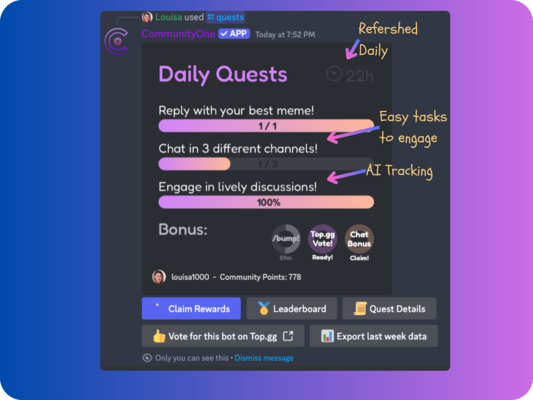
Gamified quests to prolong engagement
The transcript highlights gamified participation to drive sustained engagement and earlier time-in-server.
It specifically mentions a feature called Hype Engine.
One set of tactics described includes quests like encouraging members to chat with multiple people, which can increase proactive outreach and improve five-minute retention.
Quality Improvements: Open-Ended Welcomes and Reply Rate
Beyond onboarding mechanics, quality depends on how you structure the first interactions.
Fix the welcome format
The session recommends answering questions first, then making new-member introductions personal and open-ended.
The goal is to avoid “hit and bounce” behavior, where members only say something like a generic greeting and then leave.
Reply rate as a quality signal
The transcript frames reply rate as an indicator of engagement health.
- Target a reply rate around ~15%
When reply dynamics improve, the conversation tends to shift from “you vs. the newcomer” to peer-to-peer interaction as the community strengthens.
Moderator message length and interaction style
If new members only say “hi/good morning” and bounce, the session suggests reviewing moderator activity—specifically whether moderators are responding only with very short replies.
The implied fix: respond in a way that creates a next step for the member (longer, more human, more specific than a two-word acknowledgment).
Recognize and reward contributors
The transcript emphasizes acknowledgement: shout-outs and recognition can motivate members and improve participation quality.
It also references the motivation effect of gamification.
Practical Conclusion: Build a KPI Loop, Not a Metrics Habit
Discord analytics shouldn’t be something you look at and feel powerless about.
Use Discord Server Insights to understand traffic and high-level patterns (while accounting for incomplete/lagging data), then run an action loop with KPIs tied to the member journey:
- Verification rate (aim ~50%, avoid risky/difficult flows)
- Five-minute onboarding chat rate (aim for at least ~20% chatting)
- Five-minute chat retention (another message within five minutes)
- Conversation depth (around 4 messages per active chatter)
- Moderator performance and chat quality signals (human tone, responsiveness, better prompts)
When you measure the actions that matter—and adjust moderation, onboarding friction, and participation prompts—you turn analytics into community improvement.