Discord Masterclass: How to Triple Growth and Sustain Engagement
Summary
Most Discord growth spikes become “waste” when new members don’t stick. Build Super Fans, design a friendly first impression, track KPIs, and use quests/rewards to sustain engagement.
Discord can grow fast—members may join quickly after marketing, but then activity often drops. The masterclass summarized here argues the real goal isn’t just more members; it’s growth that converts into durable participation.
Instead of treating growth like a one-time acquisition event, the speaker recommends building sustainable engagement on purpose: create Super Fans, design onboarding that makes people want to return daily, track health KPIs, and use quests/rewards/roles in a way that encourages real conversation.
Why most Discord growth is “waste”
Most communities see a spike in server members and then low engagement. The core issue is conversion: marketing-driven joins don’t automatically turn into meaningful participation.
In the speaker’s framing, if you don’t sustain engagement, growth is essentially “waste.” In web3 communities especially, the pattern can be that new users don’t leave immediately—they behave like “bots” by joining but not engaging consistently.
So the lesson is to shift from “How do we get more people in?” to “How do we create ongoing reasons to participate once people arrive?”
The two essentials: first impression + a reason to return daily
To sustain engagement, the speaker says you need two things:
1) A friendly first impression
Moderators matter, but server design matters too. New members should quickly understand where to go and how to start participating.
2) A reason to return every day
It’s not enough for members to join once; they need a clear daily “pull” that makes returning feel worth it.
A practical implication: reduce ambiguity. If people don’t know what to do, they won’t create the daily chatter you’re aiming for.
Discord health KPIs to track (beyond member count)
The speaker recommends measuring Discord health using engagement-focused KPIs, not just total members.
Two examples from the masterclass:
- Daily chatters: track the number of members who actually chat each day
- Messages per active user: measure message volume among those active users
The speaker also describes order-of-magnitude targets from a web3 community example: around ~20 daily chatters in a ~50–60k community, and roughly ~20 messages per session (about 40 minutes). The key takeaway isn’t the exact numbers—it’s that you should define “healthy participation” for your own community and watch it consistently.
Use simple tasks that create real Discord conversation
A common onboarding failure is that new users don’t know what to do in the server, especially when they arrive in uneven conditions.
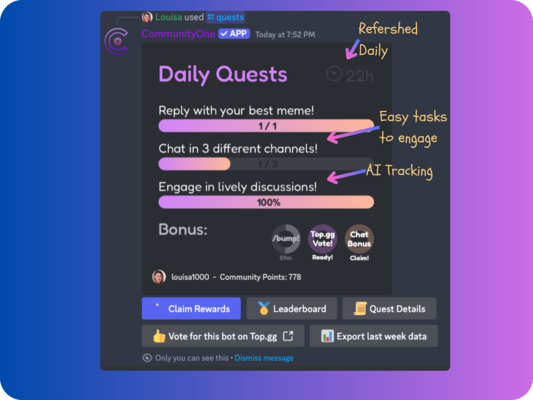
The speaker’s guidance is to kickstart interaction with small, low-knowledge tasks that encourage conversation instead of passive listening.
Examples of task types mentioned:
- Reply with a meme
- Chat across a few channels
- Join a lively discussion
Important design principle: tasks should create real engagement, not message-volume chasing.
The speaker warns against two things:
- Rewarding grinding for output (members optimizing only to collect rewards)
- Rewarding cash early (which can make the server feel like a pay-per-time transaction)
Instead, aim for low friction. If your onboarding forces people to guess, your participation will stall.
Align rewards and permissions with community goals
Rewards are only effective when they shape behavior in the direction you actually want.
The masterclass emphasizes alignment:
- If you want people to stay engaged, rewards should support staying and returning
- If you want safer, higher-quality interaction, permissions and roles should reflect that
Avoid early cash rewards
The speaker specifically cautions against cash giveaways early, because people may decide they only need to spend a fixed short amount of time to get money.
Prefer engagement-aligned rewards
An example of an engagement-aligned reward mentioned: Discord Nitro. The speaker’s point is that you should choose rewards that make sense for staying active on Discord rather than encouraging short, transactional sessions.
Use roles and permissions to guide participation
The masterclass also covers using special roles and permissions to shape what users can do.
One example discussed: controlling who can post images and links. In that setup, a special role can grant permissions (e.g., posting images and posting links). This keeps early behavior structured and makes participation more predictable.
Super Fans: definition, impact, and how to activate them
The centerpiece concept is “Super Fans.”
In the masterclass, Super Fans are members who:
- Try your product
- Give honest feedback
- Answer questions when founders are away
- Build relationships inside the community
Why this matters: Super Fans make community engagement sustainable because they help create momentum even when your team isn’t constantly present.
A signal of Super Fans in action (quest/leaderboard behavior)
The speaker describes using a quest/leaderboard mechanism where top users accumulated a points total around ~1,400. The interpretation given: these users were effectively spending about half an hour a day on the server since launch.
The principle is to look for repeat participation patterns—not one-off engagement.
How many Super Fans you need
The speaker reports that in pilots across other communities, having roughly 3–4 Super Fans per community was enough to make newcomers feel welcome.
Don’t ask Super Fans to invite personal friends directly
A key warning: the speaker says you should not ask Super Fans to invite friends directly.
The reason given is that this can feel like a grind and reduce invite quality.
Connect Super Fans to active projects (not personal invites)
Instead of “invite your friends,” the masterclass suggests a different growth mechanism: connect Super Fans to active projects they already support.
The logic is that growth depends on core members and key players driving participation—not merely having a feature or channel.
The speaker also emphasizes a balance in community presence:
- About 80% social trust-building
- About 20% product
So, Super Fans should be positioned to help create social momentum and pull people into projects, conversations, and ongoing participation—without forcing a growth task that feels mechanical.
Share what you’re working on in an authentic way
Another operational guideline: share what you’re working on in a natural, authentic way.
The masterclass includes an example scenario in general chat where the speaker shared something in-progress and asked for feedback. The broader guidance is that behind-the-scenes updates can invite community responses and help members feel like they’re part of the journey.
Shift from exclusive growth to steady engagement + growth
If you want growth that lasts, don’t treat engagement and growth as separate problems.
The speaker recommends moving from “exclusive growth” (only focusing on acquisition or spikes) to steady growth by combining:
- engagement goals (like increasing meaningful chatters)
- growth goals
A practical KPI reframe mentioned: focus on meaningful chatters (e.g., increase engaged chatters from 30 to 40) rather than only chasing total member counts.
The speaker also suggests that strengthening foundations can make future scaling healthier. If you can delay explosive growth until your community norms and onboarding are ready, you can improve the odds that new members behave in line with your community.
Quest bots and leveling systems: use them carefully
Quest/leveling can increase engagement, but the masterclass warns about unintended outcomes if they’re not designed carefully.
A specific warning: if you don’t use quests/leveling carefully, you can get “tremendous” grinding and abuse.
Avoid leaderboard farming
The example risk described is off-topic message behavior used to climb leaderboards.
Design to encourage the right behavior
The overall guidance is consistent with earlier advice:
- keep tasks low friction
- encourage real interaction
- align rewards and roles with community goals
- prevent grinding through thoughtful quest design
Start with yourself: activate advocates and moderators
The speaker also recommends starting from within the team so people can see active participation immediately.
Operational suggestion from the masterclass:
- activate at least one advocate to participate for three days
The goal is to create visible momentum so newcomers see the server is alive and responsive.
The masterclass also notes support resources like documentation and asking questions in Discord (and additional channels for help).
Conclusion
Tripling Discord growth sustainably is less about acquisition tactics and more about conversion into daily participation. Build a friendly first impression, give members a reason to return every day, track engagement KPIs like daily chatters and messages per active user, and use Super Fans to make participation resilient.
When you add quests, rewards, and roles, align them to real community behavior—and design carefully to prevent grinding and abuse. The result is growth that doesn’t just look big on a dashboard, but stays meaningful over time.