Many Discord servers don’t fail because nobody joins—they fade because the community loses momentum. To build a “forever” Discord community, focus less on raw growth and more on what people experience while participating.
This masterclass frames a research-backed playbook for long-term community health: interaction quality, purpose-driven content, structured feedback, and systems that make it easy for members to contribute.
What “Forever Community” Means (and Why Communities Fail)
A “forever community” is designed to keep working over time, instead of starting strong and then disappearing. The video points to a common pattern: communities start building and then stop.
The root causes often show up when the team “falls apart”—meaning active community work slows or stops. The talk also emphasizes that sustainable communities need ongoing reasons to exist, not just initial energy.
It highlights two failure signals that show up repeatedly:
- No new members and no fresh content, which reduces ongoing interactions.
- Lost purpose, where both managers and members stop feeling the community is worth their effort.
The video compares sustainable community building to building a startup: when leadership stops, momentum stops too.
The Study-Based Framework: Interaction Quality Over Raw Size
A key research finding in the video is that interaction quality is more important than sheer server size. According to the summary, interaction quality shows up as a top success metric for a large portion of communities (around 40% in the findings).
The point is not that growth doesn’t matter. The video acknowledges that fast growth can matter in some niches. But for long-term success, what matters most is how it feels to participate.
As described, “quality” shows up as:
- Being heard
- Relevant conversations
- Avoiding forced engagement
A practical target is also mentioned: the speaker refers to meaningful online interactions as occurring around seven daily active members (with a memory range of about five plus or minus two).
In other words, a forever community isn’t just a big room—it’s a place where the right conversations happen consistently.
Foundations: Purpose-Driven Content and Member Outcomes
The video emphasizes that there is no community for the sake of community. Instead, Discord should support specific outcomes.
The talk frames purpose in a way that maps to both managers and members:
- For managers/business: continuous learning and feedback loops (the video references user feedback and product learning as the business side of purpose).
- For members/personal: social connection and emotional support.
To make this concrete in Discord, the workshop’s foundation is about creating great content that aligns with member outcomes—not content that exists simply to post.
In this approach, success is tied to how often participants feel:
- heard
- accomplished
Build Expertise with Consistent Updates and Feedback Requests
To keep interaction quality high, the video recommends building domain expertise gradually and consistently.
One of the main tactics is a recurring cadence of updates—especially announcements that communicate what you’re working on and what you’re shipping. The summary includes an example cadence: weekly.
Those updates should not be purely celebratory; they should also create opportunities for participation. The video describes what to include in these update cycles:
- progress
- obstacles
- and where you want feedback
The underlying idea is to “learn what the community responds to” and refine the approach over time.
Design Contribution Processes: Roles, Forums, Events, and Loops
A recurring problem for community managers is that members often want to help—but don’t know what they can do beyond chatting. The video stresses the need for clear contribution actions.
Instead of relying on casual participation, build your Discord around explicit ways members can contribute.
The talk suggests structuring contribution through:
- Dedicated spaces for feedback, including forums (the summary notes using forums to “constantly ask for feedback,” and mentions two forums dedicated to feedback).
- Contribution pathways that are visible, such as applying to programs and using defined roles.
- Event participation, where members can host or run activities.
The summary also notes that contribution should progress from “a one-person effort” to participation with the server UI guiding members toward actions.
Make contribution feel actionable with visible loops
Once people know how to contribute, you need repeatable “loops” that reward engagement. The video calls out visible contribution mechanisms such as:
- voting
- member spotlights / shout-outs
- hosting within time zones (to keep participation inclusive)
This is paired with ongoing structured engagement through recurring updates (weekly announcements, blogs, and monthly workshops are mentioned in the outline).
Retention Systems: Being Heard, Feeling Accomplished, and Emotional Support
Long-term Discord retention is tied to both feedback responsiveness and emotional experience. The video compresses the retention goal into two outcomes:
- being heard
- feeling accomplished
It also frames emotional support as part of the personal purpose of community.
Fast, responsive feedback loops
The talk describes feedback as something that should be turned into an ongoing conversation, not a dead-end request.
The approach includes:
- responding to every input
- acting quickly when possible
- turning feedback into follow-up discussions
To make this scalable, the summary notes the importance of using community support systems rather than unlimited one-off 1:1 help. For example, help can be handled through community spaces like Discord/forums so members can get answers efficiently.
Check in daily to capture feedback and help needs
A practical routine is also included: the speaker checks the Discord daily, typically in the afternoon.
What they look for includes:
- feedback
- help
- suggestions
The summary notes that resources are limited, so this model depends on people who genuinely care about the product/bot and are willing to provide feedback—alongside the idea that the whole team actively monitors and uses Discord.
Use structured activities and light competitions
To support “feeling accomplished,” the video recommends building structured ways for members to engage with progress and recognition.
The summary includes activities that create a rewarding cycle, such as:
- challenges
- progress sharing
- voice sessions
- accountability and structured activities
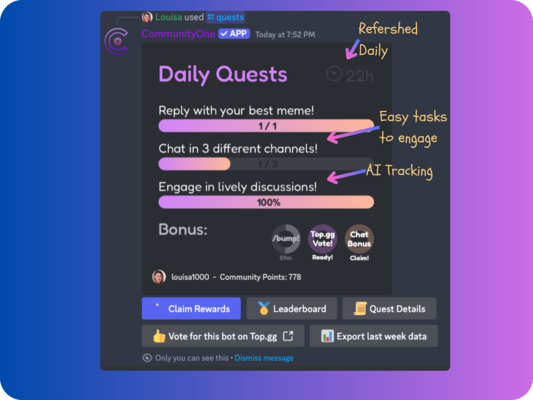
- light competitions (leaderboards, quests, hall-of-fame style recognition)
These elements help make returning feel worthwhile—socially and personally.
Putting It All Together: A Practical Forever-Community Setup
Based on the framework in the video, a durable Discord “forever” community typically includes:
- Interaction quality as the metric, not just growth
- Purpose-driven content tied to clear member outcomes
- Consistent shipping/expertise updates (e.g., weekly) that include where you want feedback
- Clear contribution pathways (forums, roles, events)
- Contribution loops like voting and member spotlight/shout-outs
- Retention systems built on being heard, feeling accomplished, and emotional support
- Fast feedback routines, including daily check-ins and scalable help channels
Conclusion
Building a forever Discord community isn’t about posting more—it’s about creating the right experience consistently. Prioritize interaction quality, define purpose, make contribution easy with clear processes and loops, and retain members through responsive feedback plus systems that help them feel heard and accomplished.