Building a “forever” Discord community is less about hitting a huge follower number and more about staying useful, engaging, and sustainable over time. Many Discord servers burn out early because they stop attracting new members, run out of fresh content, lose their purpose, or can’t keep the team effort going.
This guide distills the framework from the video into practical systems you can apply: interaction quality, content with a clear purpose, a repeatable way for members to contribute, and feedback loops that make people feel heard.
Why Discord communities fail (and why “forever” is different)
Discord communities often have a short lifespan for predictable reasons:
- No new members: without incoming participants, activity eventually fades.
- No fresh content: discussions stall when there isn’t anything new to talk about or do.
- Loss of purpose: when the community no longer feels meaningful, people stop investing time.
- Team collapse: at scale, community management can fall apart when responsibilities or transitions aren’t sustainable.
- High management cost: if running the server requires constant effort from a small group, burnout is likely.
A key framing in the workshop is that community building can be like building a startup: it tends to keep going only while the people running it still find it worth the effort. When motivation drops, the community drops with it.
What research suggests: prioritize interaction quality over server size
A central insight from the session is that interaction quality predicts success more strongly than raw server size.
The speaker emphasizes a realistic target for meaningful engagement: around seven daily active participants, often described as “five plus or minus two.” The point isn’t to chase vanity metrics—it’s to build for the level of participation where conversations actually happen.
If your community feels forced, shallow, or purely transactional, it’s a sign that interaction quality is too low. Quality affects not only retention, but also the well-being of the people moderating or facilitating.
Build your “forever” community around content and purpose
The video stresses the idea that there is “no community for the sake of community.” Discord shouldn’t be an empty hangout—it should connect to something members genuinely care about.
Instead, build your community around real use cases, such as:
- Content consumption (members discuss what they’re watching/reading/learning)
- Product usage (members use something together and share outcomes or ideas)
- Feedback loops (members help shape the next improvements)
The workshop notes that good community content ties to expertise and to what the audience truly cares about. When the server naturally supports the topics and routines people already have, your content becomes repeatable and less “manufactured.”
Create repeatable contribution paths (not just chat)
One of the biggest practical problems is that people know how to talk in Discord, but they may not know what actions help improve the community.
To solve this, the session recommends designing a clear contribution process:
- Define what members can contribute (specific actions, not vague participation)
- Build server channels and prompts around those actions
- Use examples and structured invitations so members can quickly understand how to help
The goal is to shift from a one-person effort to systems where members can take action.
Use Discord weekly announcements to drive participation
To keep activity from stalling, the video highlights weekly announcements as a simple mechanism to focus the community.
A strong weekly announcement should clearly cover:
- What’s been shipped
- What obstacles are being worked through
- Where you need feedback
Over time, these updates also help your server build momentum around the work you’re actually doing, which reinforces your purpose.
Pair announcements with forums for feedback
Announcements tell members what’s happening; forums tell members where to contribute.
The workshop specifically calls out using dedicated feedback forums so people know exactly what to post and where. This is especially useful for ongoing feedback collection (for example, feedback categories like bot or product feedback).
When feedback is routed into the right place, you reduce confusion and make it easier to respond.
Design contribution around member actions (examples of formats)
Rather than relying on spontaneous participation, the video recommends building your server around member actions. It mentions structured formats such as:
- Monthly votes
- Applying to host events by time zone
- Member shoutouts
- Hosting watch parties or live matches
In other words, members aren’t only consuming content—they can become contributors through defined roles and repeated activities.
For communities that involve product improvements or expertise, the session also describes contribution systems that let members demonstrate and validate what they know (for example, feedback-based applications). The exact mechanism depends on your community’s purpose.
Make feedback loops central: “being heard” retention
A durable community needs retention systems, and the video focuses on two retention levers:
- Being heard
- Feeling accomplished
Being heard: respond quickly and treat feedback as a conversation
The workshop frames feedback as “the beginning of a conversation.” That means you should:
- Respond quickly (even if the idea sounds ridiculous)
- Act on suggestions fast when appropriate
- Treat feedback as ongoing dialogue, not a one-time ticket
When members see that their input leads to action, they’re more likely to keep participating.
Feeling accomplished: build activities that create progress
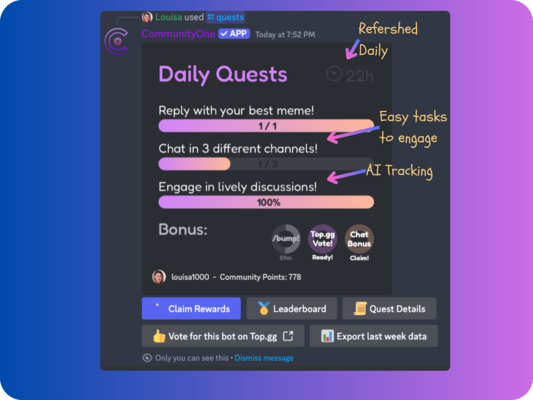
The session also emphasizes motivation through accomplishment. It mentions activities that can help members feel progress, such as:
- Learning challenges
- Study sessions
- Voice/chat milestones
- Competitions with leaderboards
- Special roles
These formats support retention by giving members reasons to return—not just to chat, but to improve, contribute, and measure growth.
Use scalable support and emotional support together
Purpose isn’t only about what the community does; it’s also about how help and support work.
The video outlines purpose categories that can support long-term participation, including:
- Technical support (scalable help, where support isn’t overwhelmed by one-off requests)
- Business/product feedback
- Learning or inspiration from new features
It also highlights the importance of making Discord feel personal:
- Provide emotional support
- Help members feel seen
- Foster friendships over time
When members feel supported both practically and emotionally, the server becomes harder to abandon.
Conclusion: a practical checklist for a “forever” Discord server
To build a “forever” Discord community, focus on systems that sustain real participation:
- Prioritize interaction quality over server size (aim for meaningful daily activity)
- Tie the server to a clear purpose tied to real routines (content, product usage, or feedback)
- Ship consistently and use weekly announcements that state what’s been done and what feedback is needed
- Create clear contribution paths with forums and structured member actions
- Run feedback loops that make members feel heard by responding quickly and acting fast
- Increase retention with accomplishment and emotional support through challenges, milestones, leaderboards, and personal connection
If you build for quality, purpose, contribution, and feedback, your Discord community has a much better chance of lasting beyond launch.