Discord analytics only matter if they help you change what you do next. This guide turns Discord’s available data into practical, action-driven KPIs—so you can improve onboarding, increase early engagement, protect chat quality, and support responsible growth.
We’ll cover what you can measure (including Discord Server Insights when available), what to track in the critical first minutes, and which moderator and community health metrics align with real outcomes.
What Discord analytics you can access (and what to do when data is limited)
Discord offers analytics through a server panel called Server Insights (availability can vary). When it’s available, you can review analytics related to your server, including:
- Traffic sources (for example, where members came from via invite/referral links)
- Announcement impact and which channels drive activity
- User demographics such as location, which can help you decide on language-specific channels
Important limitations to keep in mind:
- Server Insights data may be incomplete or lagged, so treat it as directional rather than perfect.
- Some of the most meaningful engagement diagnostics still require you to interpret behavior patterns (like early drop-off or one-message users) rather than only relying on dashboards.
Use action-driven analytics: measure the moments that shape behavior
A common frustration with analytics is looking at metrics you can’t translate into changes. Instead, adopt action-driven analytics:
- Identify the user stage that matters.
- Measure what happens in that stage.
- Take operational action to improve the stage.
In Discord communities, the stages emphasized are:
- Technical onboarding: invite click → welcome flow → verification → first steps inside the server
- Engagement stages: after the first message, after five minutes of chatting, and later retention signals
The goal is to connect metrics to operational decisions, so data leads to adjustments instead of frustration.
Action-oriented moderator & chat quality KPIs
Community goals often depend on call-to-actions. Track outcomes that reflect real behavior—especially what moderators do to shape conversations.
Moderator performance KPIs
A practical approach is to measure moderator influence by focusing on engagement behaviors moderators can directly affect, such as:
- How many people moderators talk to
- How moderators engage new members, particularly in smaller servers
This framing matters because chat quality is heavily influenced by how moderators communicate and guide newcomers. Moderators shouldn’t only manage activity—they should model the tone and help new members know what to do next.
Chat quality signals (what to look for as the server grows)
Chat quality can be reflected in reply behavior and the “depth” of communication.
As engagement grows, a quality benchmark mentioned is:
- Roughly ~15% of messages get replied
If you see low reply behavior, it can be a sign that people aren’t getting prompts to respond to each other, or that moderation and onboarding aren’t doing enough to seed conversations.
Use Server Insights for traffic, announcements, and demographics
When Server Insights is available, use it to answer operational questions:
Which channels actually drive traffic?
The analytics support channel-level understanding. In particular, announcements can be disproportionately impactful. A benchmark mentioned:
- Good announcements can drive about four times more traffic than other channels
Use this to decide where to focus your communication effort and how to structure announcement content so it results in member movement toward the right channels.
Where do your members come from?
Server Insights can show traffic sources, such as members arriving via Google versus Discord referral routes. Use that to refine your acquisition approach and content promotion.
Because the data may be incomplete or lagged, confirm with onboarding and engagement patterns (if a traffic source brings low-quality or disengaged users, you’ll typically see it in early chat metrics).
Location and demographics for community structure
Server Insights can show user locations once they reach a visibility threshold (for example, around 5%+).
This helps you decide:
- Whether you need language-specific channels
- How to tailor onboarding or prompts to match audience distribution
Onboarding analytics: track verification rate and the first 5 minutes
The first experience after an invite click is where most data-driven improvements can happen.
Focus metric: first five minutes after invite
Rather than only counting signups, measure what happens in the first ~5 minutes after someone joins through your invite link—especially:
- Verification completion speed
- Drop-off points
- Whether users start chatting
Verification rate benchmarks
Verification rate is a key onboarding KPI. Benchmarks mentioned include:
- Aim for around 50% verification rate
- Ideally 75%+
- Top servers may reach ~80%
Verification should also be fast. A target mentioned is:
- Under 30 seconds for verification completion
Reduce friction (and avoid risky verification flows)
Onboarding verification can either protect your community or harm it. Avoid verification methods that:
- Require users to leave Discord for verification links where scams could occur
- Are harsh on mobile (for example, mobile-hostile CAPTCHAs)
- Add excessive friction via aggressive bot-verification prompts
To mitigate bot raids, tighten onboarding steps mentioned in the video include:
- Phone verification
- Optionally blocking newly created accounts from joining
- A goal of keeping completion time under 30 seconds
Engagement benchmarks: aim for 20%+ chatting in the first 5 minutes
After verification, the next critical question is: Do new members actually participate?
A benchmark emphasized is:
- 20%+ of new users chat in the first ~5 minutes
A higher observed max mentioned is:
- Potentially 20% to 50% in better-performing communities
If the “first 5 minutes chat” metric is low, diagnose onboarding and server clarity
Low early chatting can come from:
- Too many unclear channels, causing decision fatigue
- Overly complicated onboarding steps or surveys
- Moderation and communication gaps where newcomers don’t know what to do
Watch for extremes: “too good” or “nonsense” dynamics
Two specific engagement failure modes mentioned are:
- Servers that feel too good can intimidate newcomers (even if the community is high-quality)
- Servers that devolve into low-value posting can push users out quickly
Moderator onboarding as hosting
A practical takeaway: if you have moderators who greet newcomers and show what’s happening, you should see better onboarding-to-chat outcomes. This is an operational lever connected directly to the metric (percentage of users chatting early).
Keep daily conversation healthy: the “magical number seven”
A lively community is often described in terms of consistent participation.
A benchmark mentioned is:
- Around seven daily chatters (or seven across an equivalent 12-hour period)
To reach that level, the community needs a steady inflow of members who either:
- Show up and chat at least once, or
- Return and continue participating
If your server feels quiet, engagement analytics can help you understand whether the issue is:
- Low onboarding success (new members don’t convert to chatters)
- Low returning participation (active members drop off)
One-message rate and 5-minute chat retention
One-message rate (one-and-done behavior)
Track the share of members who send exactly one message.
A high one-message rate can indicate:
- Users leave because their need (question, prompt, help request) didn’t get answered
- People aren’t receiving a good path into conversation
The video highlights using this metric to diagnose whether users are bouncing due to unanswered needs.
5-minute chat retention KPI
Another emphasized KPI is:
- Five-minute chat retention: what percentage keep chatting within five minutes after their first message
Improve it by giving people reasons to interact, including:
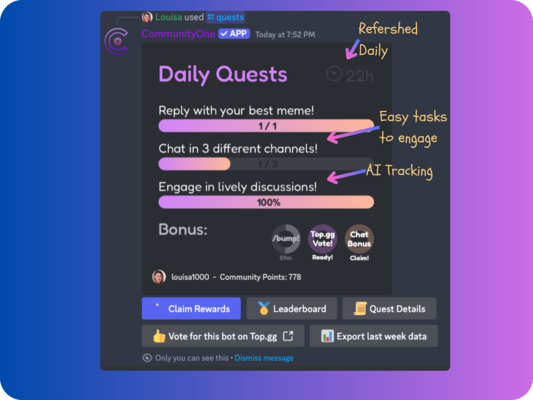
- Gamified or prompted engagement (examples mentioned include quest-style mechanics)
- Concrete prompts like “chat with three people”
Tools and bots were referenced as ways to support prompts and quests, such as Hype Engine.
Engagement depth: messages per chatter (communicator matrix)
Beyond “did they chat,” measure “how deep did the conversation go?”
A metric mentioned is messages per chatter/communicator, described as a “communicator” depth approach.
The intent is to approximate time and engagement depth:
- A message is estimated to take roughly 30 seconds to 2 minutes
- About 4–5 messages per chatter corresponds to roughly 5–10 minutes spent communicating
The video also notes that talking to friends makes additional messages easier, while talking to strangers can make it harder—so onboarding and moderation should encourage newcomers to find conversation partners.
A practical prompt approach mentioned:
- Start conversations by asking something personal but not too impersonal
- Use profile interests or connected links (examples referenced include Spotify/Steam/X) as conversation starters
Improve quality and replies: open dialogue and a reply benchmark
To increase conversation depth and reduce the “welcome message only” problem, the video recommends:
- Answer newcomers’ questions first
- Then give them an easy entry into a longer, more open-ended conversation (for example, asking how they heard about you)
Quality metrics mentioned include the reply benchmark:
- About ~15% of messages get replied
This is useful as a health check: as engagement strengthens, reply behavior should improve and moderators may need less direct intervention.
Use analytics to support retention and prevent churn
Discord analytics can also help with retention and human-centered moderation.
A practical approach highlighted:
- Track when members drop off and tag them on their last active days
- Check in with them—there can be real-life reasons they can’t participate
Acknowledgement and social recognition were also mentioned as motivation:
- Reward increasingly active members with public shout-outs
Finally, while the video previews growth analysis tied to bot/quest engagement, it also emphasizes responsible growth practices:
- Avoid strategies that incentivize invites in ways that increase bot traffic
Conclusion
To transform your community with Discord analytics, focus on what you can measure that directly changes outcomes: onboarding friction (verification rate and speed), early engagement conversion (20%+ chatting in the first five minutes), momentum (five-minute chat retention), and conversation quality (one-message rate, reply behavior, and messages per chatter).
When Server Insights is available, use it for traffic sources, announcement impact, and demographics—but always connect analytics to concrete operational actions, especially around how moderators greet newcomers and guide early conversations.