Hollow Point Trading
Hollow Point Trading Discord server banner
Hollow Point Trading Discord server icon

Hollow Point Trading

233 online2.3K members

Hollow Point Trading Updates & Events

Server Updates & Events

Announcements

AMD Missing Minute: Why No Row Isn’t a Flat Candle

https://youtu.be/2OsHN5_CnWg

AMD: a missing minute is not a flat candle #Shorts


A missing data row is not evidence that a stock stopped trading. This historical AMD IEX extract has observations stamped fifteen ten, fifteen eleven, fifteen thirteen, and fifteen fourteen UTC. There is no fifteen twelve row in this five minute window. That gives four observed minute bars, not five. It does not establish zero trading across eve...

AMD Missing Minute: Why No Row Isn’t a Flat Candle

JPM True Range: Why It Exceeds Candle Range

https://youtu.be/puxkwCXlsKA

JPM: why true range exceeds the candle range #Shorts


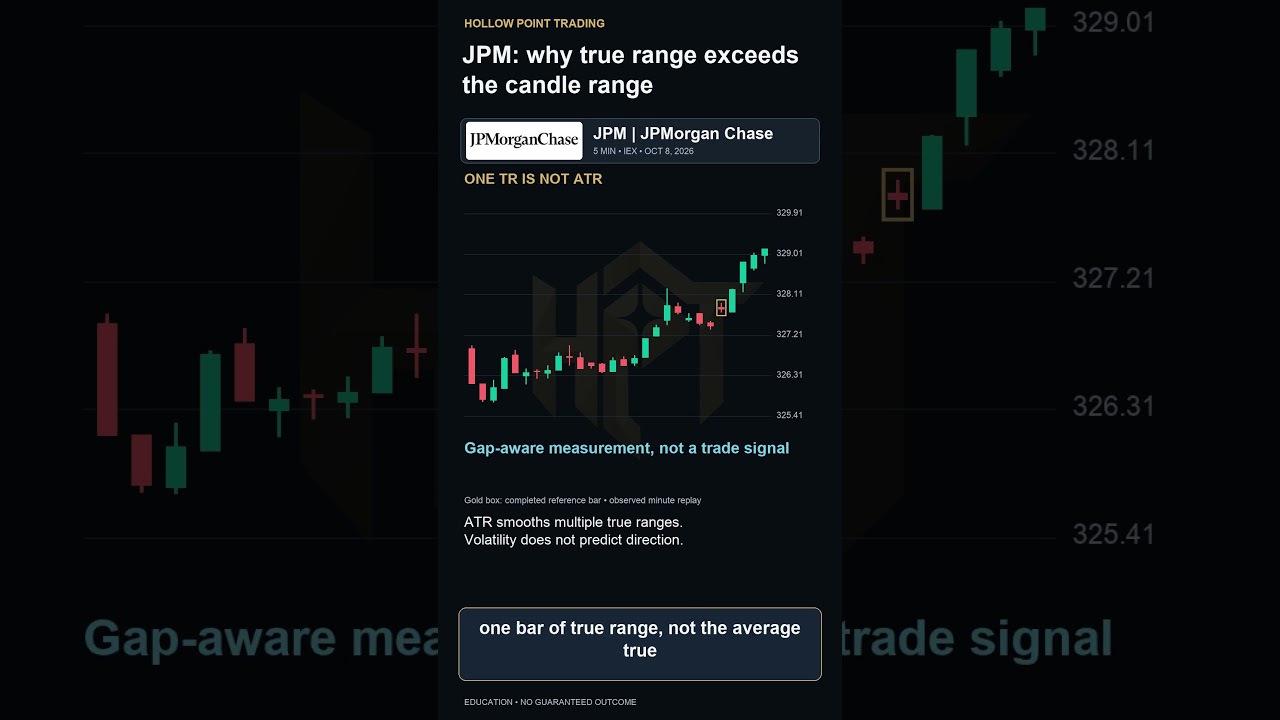
A small candle range can miss a gap from the previous close. In this historical JPMorgan IEX example, the highlighted five minute bar has a high of three twenty seven point nine two and a low of three twenty seven point seven two. Its high minus low is twenty cents. But the previous bar closed at three twenty seven point four one. The distance f...

JPM True Range: Why It Exceeds Candle Range

MSFT: Why a Five-Minute Close Isn’t an Average

https://youtu.be/HcU5U3zDHXE

MSFT: a five-minute close is not an average #Shorts


A five minute candle close is not the average of five closes. This Microsoft example uses historical IEX observations from October eighth, twenty twenty six. The highlighted interval begins at fifteen ten UTC. It contains five one minute bars. The first open is five thirty point nine zero. The highest high is also five thirty point nine zero. Th...

MSFT: Why a Five-Minute Close Isn’t an Average

How Borrowing Boosts Cash Without Increasing Sales

https://youtu.be/_uf-yGgl7SA

Borrowing can increase cash without creating sales #Shorts


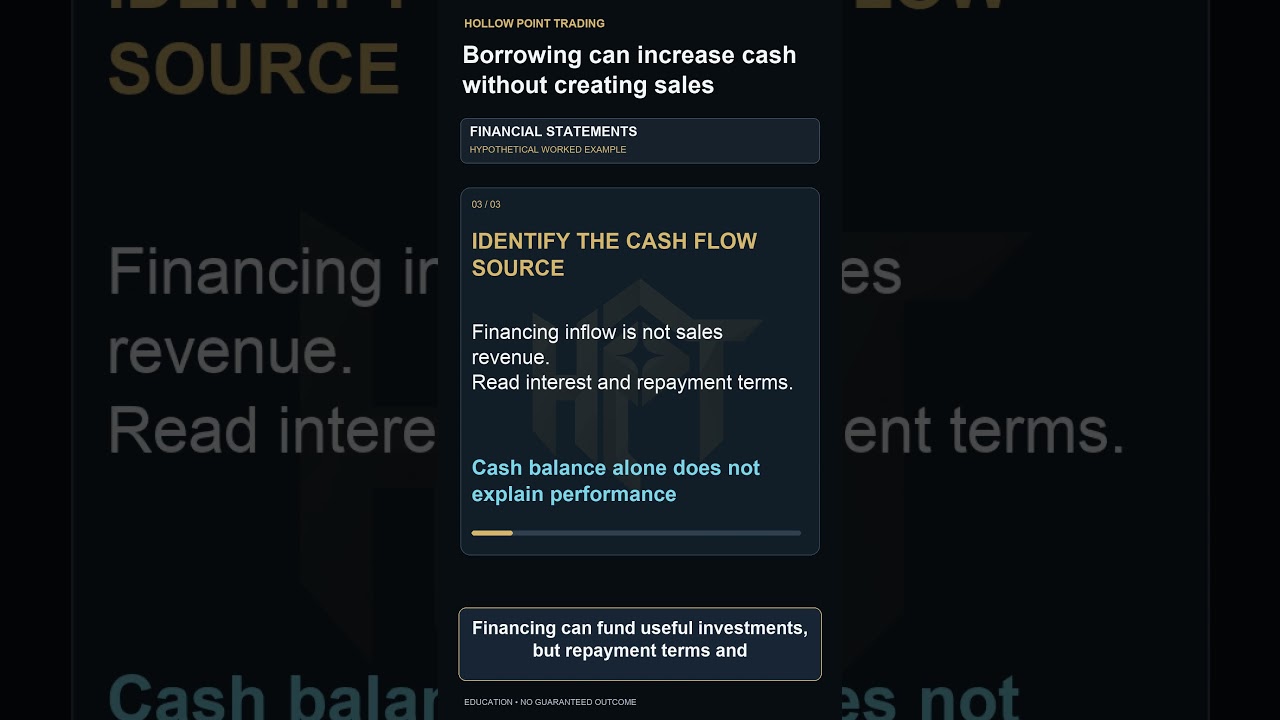
A rising cash balance does not necessarily mean customers bought more. Imagine a business starts with twenty thousand dollars in cash and borrows eighty thousand dollars. Ignore fees and all other activity in this simplified example. Cash rises to one hundred thousand dollars, but debt also rises by eighty thousand. The loan proceeds are a finan...

How Borrowing Boosts Cash Without Increasing Sales

Why the Current Ratio Can Hide Cash Shortages

https://youtu.be/bfMaNzPRlm8

A current ratio can hide a shortage of cash #Shorts


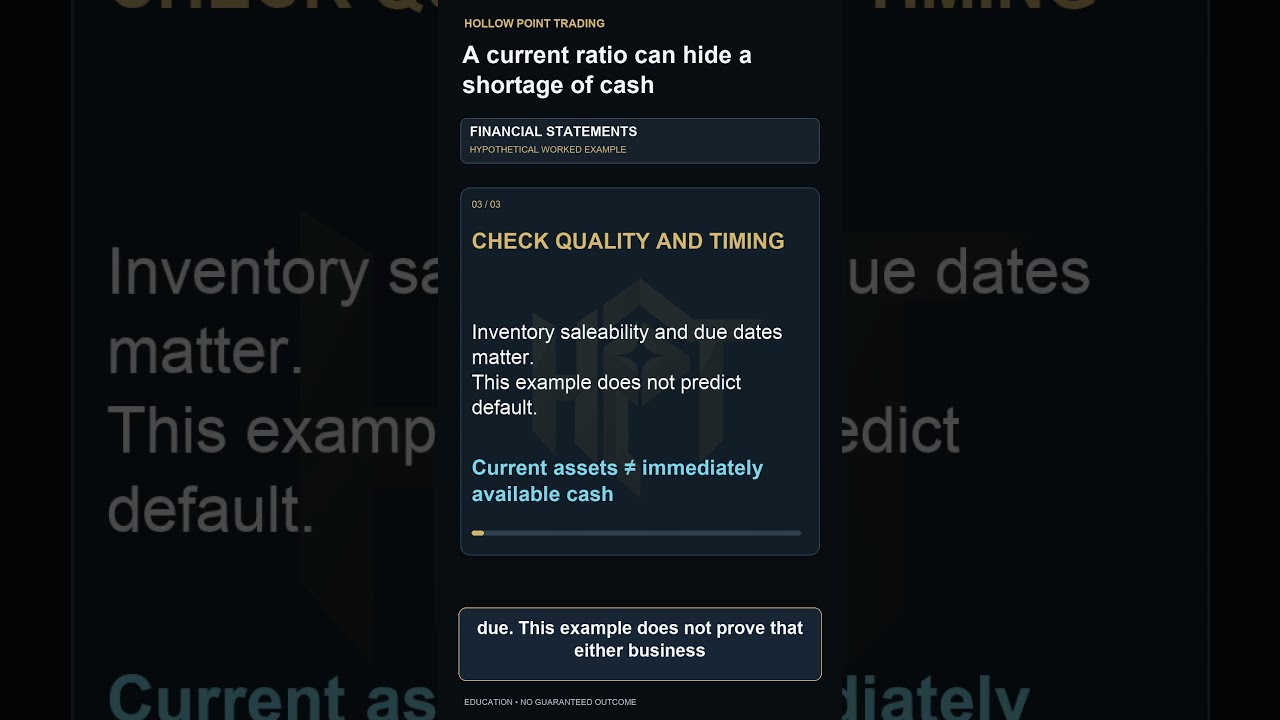
Two businesses can show the same current ratio and very different cash situations. Imagine each has two hundred thousand dollars of current assets and one hundred thousand dollars of current liabilities. Both current ratios equal two. In the first business, one hundred eighty thousand dollars of those assets is cash. In the second, only twenty t...

Why the Current Ratio Can Hide Cash Shortages

Depreciation Explained: Spreading Equipment Costs

https://youtu.be/-o3Sy8_W5xs

Depreciation spreads a cost without repeating the cash purchase #Sh...


Depreciation is not another cash purchase every year. Imagine a business pays fifty thousand dollars in cash for equipment. Assume a five year useful life, no residual value, and straight line depreciation for this simplified example. The annual depreciation expense is ten thousand dollars. The original fifty thousand dollar payment and the annu...

Depreciation Explained: Spreading Equipment Costs

Accrued Interest: Earned Before Cash Arrives

https://youtu.be/rcI2BSfIYYg

Earned interest is not always cash already received #Shorts


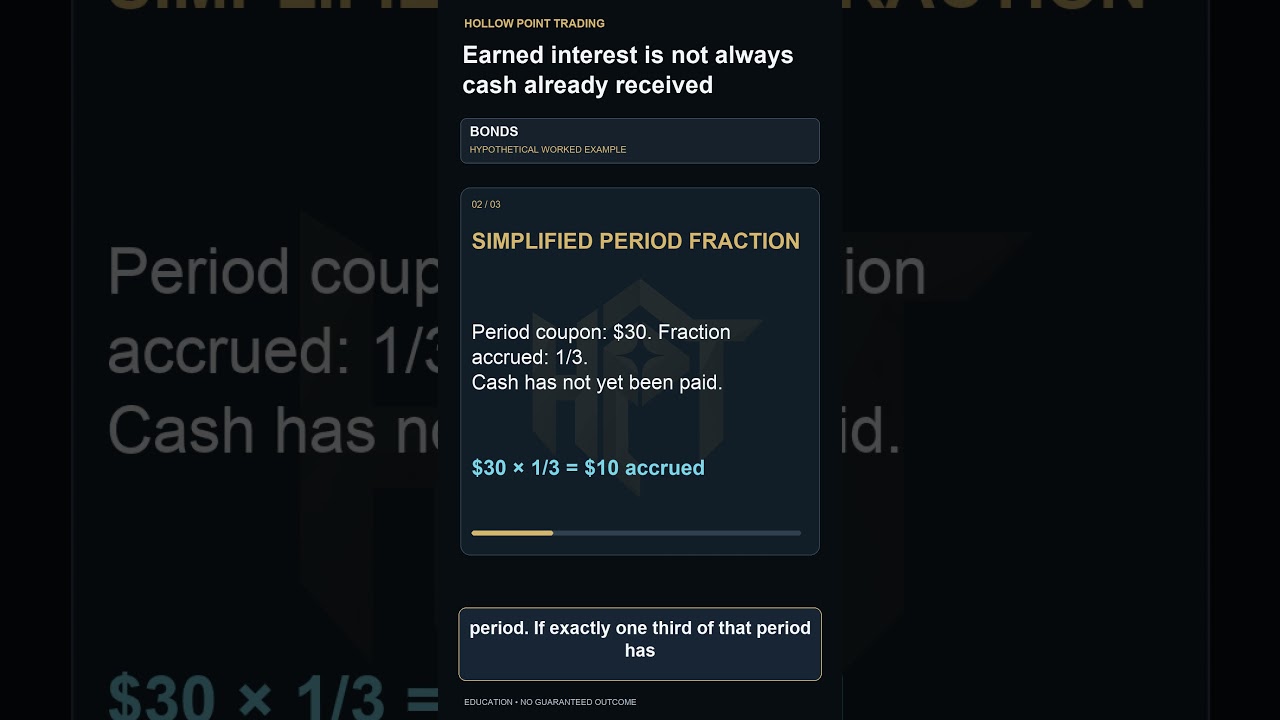
Interest can be earned before cash arrives. Accrued interest means interest earned on a security but not yet paid to the investor. That distinction matters when a bond pays coupons only on specified dates. Imagine a bond promises a thirty dollar coupon for a coupon period. If exactly one third of that period has accrued under its applicable conv...

Accrued Interest: Earned Before Cash Arrives

How a 10% Stock Drop Can Cut Equity by More

https://youtu.be/mk8F_ZFejA4

A small asset drop can become a larger equity loss #Shorts


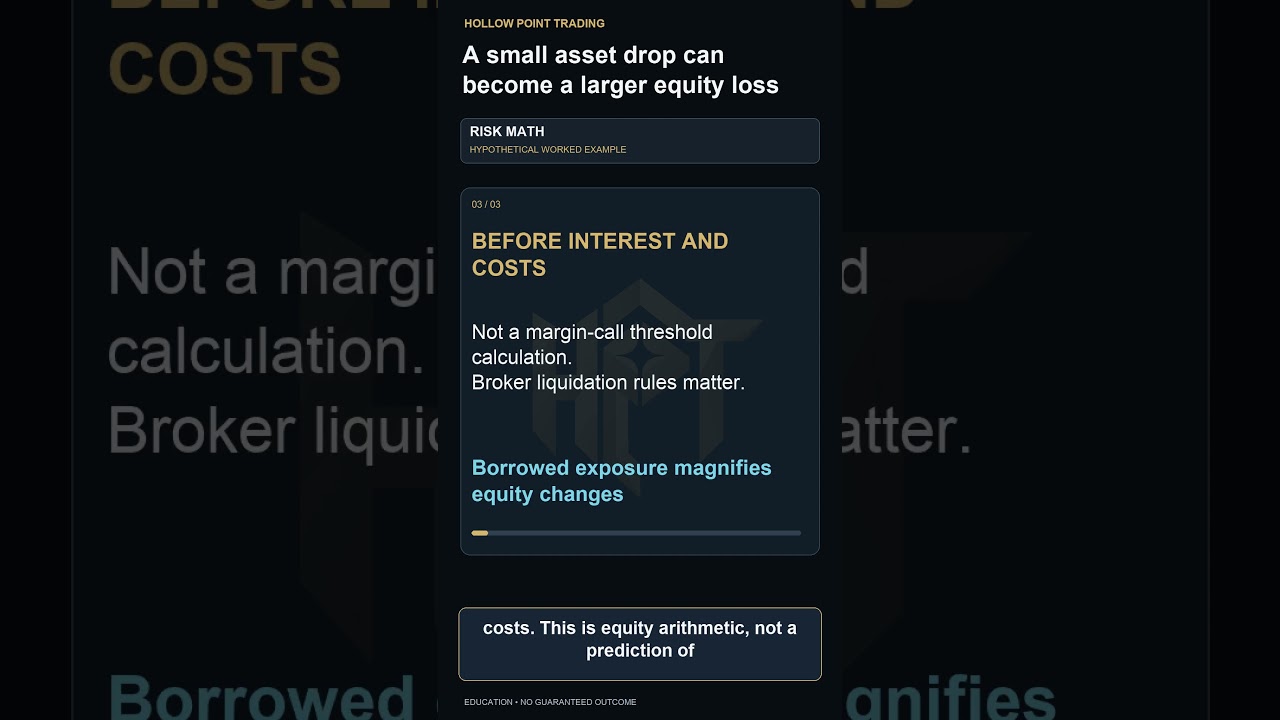
A ten percent stock decline can reduce your own account equity by much more. Imagine buying ten thousand dollars of stock using five thousand dollars of your cash and five thousand borrowed dollars. Starting equity is five thousand dollars. Now the stock value falls to nine thousand dollars. The five thousand dollar loan has not disappeared. Sub...

How a 10% Stock Drop Can Cut Equity by More

Zero-Coupon Bonds: How Returns Work

https://youtu.be/5ahp8eHoS-g

Zero coupon does not mean zero return #Shorts


Zero coupon does not mean zero potential return. Imagine paying nine hundred dollars for a bond that promises one thousand dollars at maturity two years later. It makes no periodic coupon payments during those two years. If the issuer pays as promised, the difference is one hundred dollars before taxes and costs. Relative to the nine hundred dol...

Zero-Coupon Bonds: How Returns Work

Fund Distributions Don’t Create Extra Wealth

https://youtu.be/-Q5rcQ2z-HE

A fund distribution is not free extra account value #Shorts


A fund payout does not automatically create extra wealth. Imagine owning one hundred mutual fund shares at a twenty dollar net asset value. Your holding is worth two thousand dollars before a distribution. Assume the fund distributes one dollar per share in cash and nothing else changes. Net asset value falls to nineteen dollars. You now have ni...

Fund Distributions Don’t Create Extra Wealth

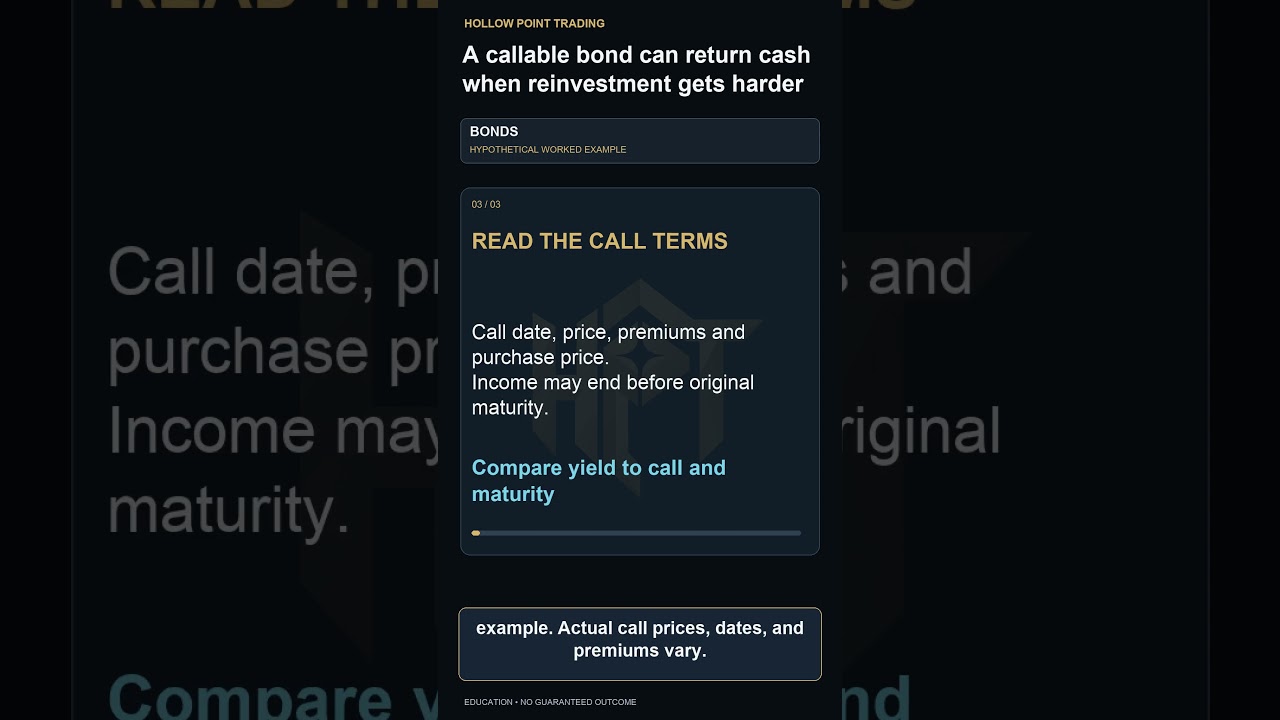
Callable Bonds: Reinvestment Risk Explained

https://youtu.be/FInRnCmrYDM

A callable bond can return cash when reinvestment gets harder #Shorts


A callable bond can return your principal just when comparable income becomes harder to find. Imagine a bond with one thousand dollars of face value pays a six percent annual coupon. That means sixty dollars of annual coupon income. Assume its terms permit a call at par and the issuer redeems it. If you reinvest that thousand dollars at four per...

Callable Bonds: Reinvestment Risk Explained

Inventory Turnover: Measure How Fast Stock Moves

https://youtu.be/mdg9DDU6wEc

Inventory turnover measures movement, not just a warehouse total #S...


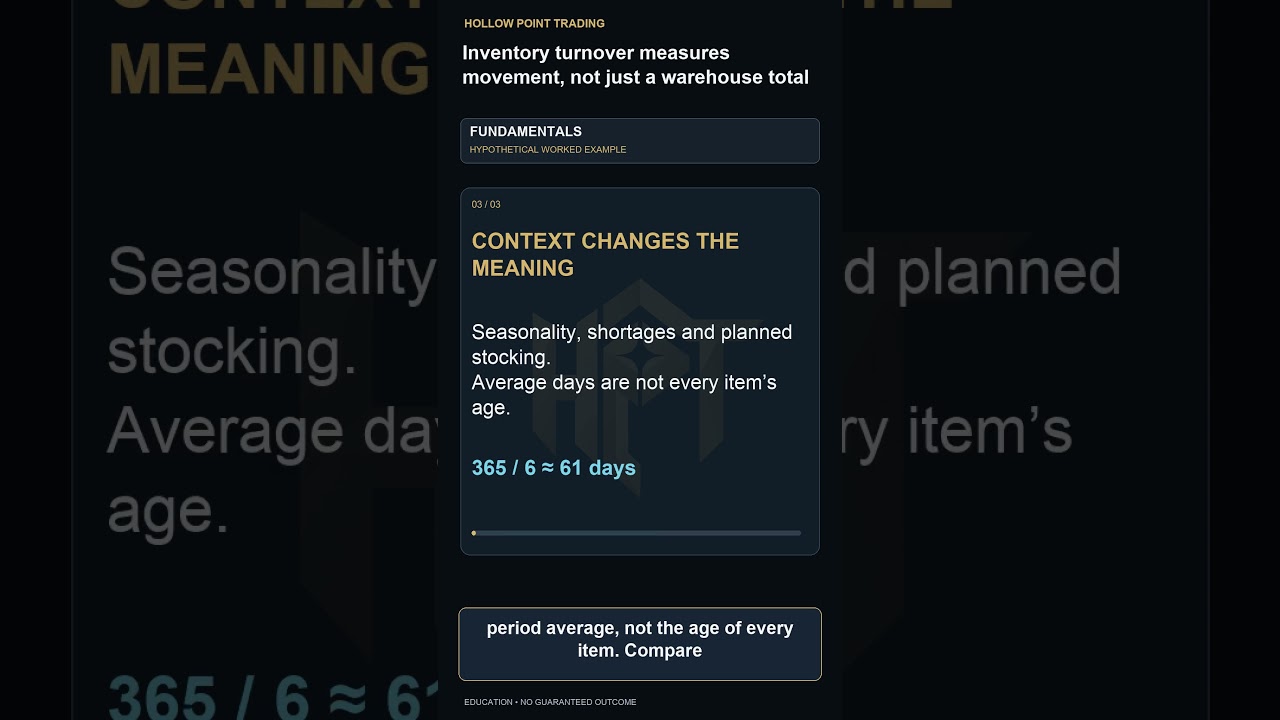
A warehouse total alone cannot tell you how quickly products move. Imagine annual cost of sales is six hundred thousand dollars and average inventory at cost is one hundred thousand dollars. Keep both measurements on a cost basis. Dividing annual cost of sales by average inventory gives six turns per year. Using a three hundred sixty five day ye...

Inventory Turnover: Measure How Fast Stock Moves

Call Spread Profit: The Expiration Ceiling Explained

https://youtu.be/4wP1-pcWWtk

A call spread has an expiration ceiling #Shorts


A rising stock does not give a call spread unlimited upside. Imagine buying a fifty strike call and selling a fifty five strike call on the same stock, with the same expiration. The net debit is two dollars per share. At expiration, the spread value cannot exceed the five dollar strike width. Maximum profit is three dollars per share before cost...

Call Spread Profit: The Expiration Ceiling Explained

Why Equal Market Caps Can Mean Different Debt Risk

https://youtu.be/_CcCMTzu8oo

Two equal market caps can hide different debt burdens #Shorts


Two companies with equal stock market values can have different financing burdens. Imagine each has a one billion dollar equity market value. Company A has three hundred million dollars of debt and one hundred million in cash. In a simplified enterprise value calculation, add debt and subtract cash. Company A's enterprise value is one point two ...

Why Equal Market Caps Can Mean Different Debt Risk

Why One Loss Can Shift Your Trading Win Rate

https://youtu.be/h3ZIsZ8rYtQ

One loss can sharply move a tiny win-rate sample #Shorts


Eight wins out of ten trades looks like an eighty percent win rate. But a small sample can move sharply with just one observation. Imagine the next trade loses, leaving eight wins out of eleven. The observed win rate is now about seventy two point seven percent. Nothing about that arithmetic proves the strategy's true future win probability. The...

Why One Loss Can Shift Your Trading Win Rate

Why a Positive Fund Return Can Still Underperform

https://youtu.be/ilvwwrgWcEU

A positive fund return can still trail its comparison #Shorts


A positive return does not tell you whether a fund kept pace with its comparison. Imagine a fund gains eight percent during a year while its stated benchmark gains twelve percent over the same period. The fund trails by four percentage points, even though an investor made money before any personal taxes. That difference is not a four percent los...

Why a Positive Fund Return Can Still Underperform

Stop Orders: Why Your Exit Price Isn’t Guaranteed

https://youtu.be/G_auf2kVrLs

Your stop price is a trigger, not a guaranteed fill #Shorts


A stop price is not a guaranteed exit price. Imagine buying a stock at fifty dollars and placing a sell stop at forty eight. Your planned difference is two dollars per share, before costs. Now imagine news arrives overnight and the next available execution is forty five dollars. Once triggered, a regular stop becomes a market order. In this hypo...

Stop Orders: Why Your Exit Price Isn’t Guaranteed

Yield Curve Steepening: Two Paths Explained

https://youtu.be/alpF2J6Vv6k

A yield curve can steepen through two different paths #Shorts


A steeper yield curve does not tell you which end moved. In a hypothetical example, a short maturity yields four percent and a long maturity yields five percent. The long minus short spread is one percentage point. One path lowers the short yield to three percent while the long yield stays five. Another leaves the short yield at four while the l...

Yield Curve Steepening: Two Paths Explained

Why Producer Inflation Doesn’t Predict Consumer Prices

https://youtu.be/XkFjkP-t-nA

Producer inflation is not a mechanical forecast of consumer inflati...


A producer price increase does not translate one for one into consumer inflation. Producer indexes measure selling prices received by domestic producers. Consumer indexes measure prices paid by consumers. Coverage, weights, and pricing stages differ. Imagine one product sells for one hundred dollars and includes twenty dollars of a particular in...

Why Producer Inflation Doesn’t Predict Consumer Prices

Customer Concentration Risk: A $40M Revenue Example

https://youtu.be/gAN1rrYpXu8

A growing business can depend heavily on one customer #Shorts


Total revenue can hide dependence on one customer. Imagine a business with one hundred million dollars of annual revenue. One customer accounts for forty million, or forty percent. If that customer cuts purchases in half and everything else stays unchanged, revenue falls by twenty million dollars to eighty million. This is a sensitivity scenario...

Customer Concentration Risk: A $40M Revenue Example

Why 10 Stock Holdings Can Still Share One Risk

https://youtu.be/XD5WQOqimNE

Ten holdings can still share one major risk #Shorts


Ten holdings do not automatically mean ten independent risks. Imagine ten equal positions, each worth one thousand dollars. If all depend on the same industry, a shared shock can affect every holding. In a hypothetical stress scenario, each position falls twenty percent. The ten thousand dollar portfolio loses two thousand dollars. Adding more n...

Why 10 Stock Holdings Can Still Share One Risk

Why Profit Growth Can Shrink Earnings Per Share

https://youtu.be/ZT5BNVQ57AI

Profit growth can disappear on a per-share basis #Shorts


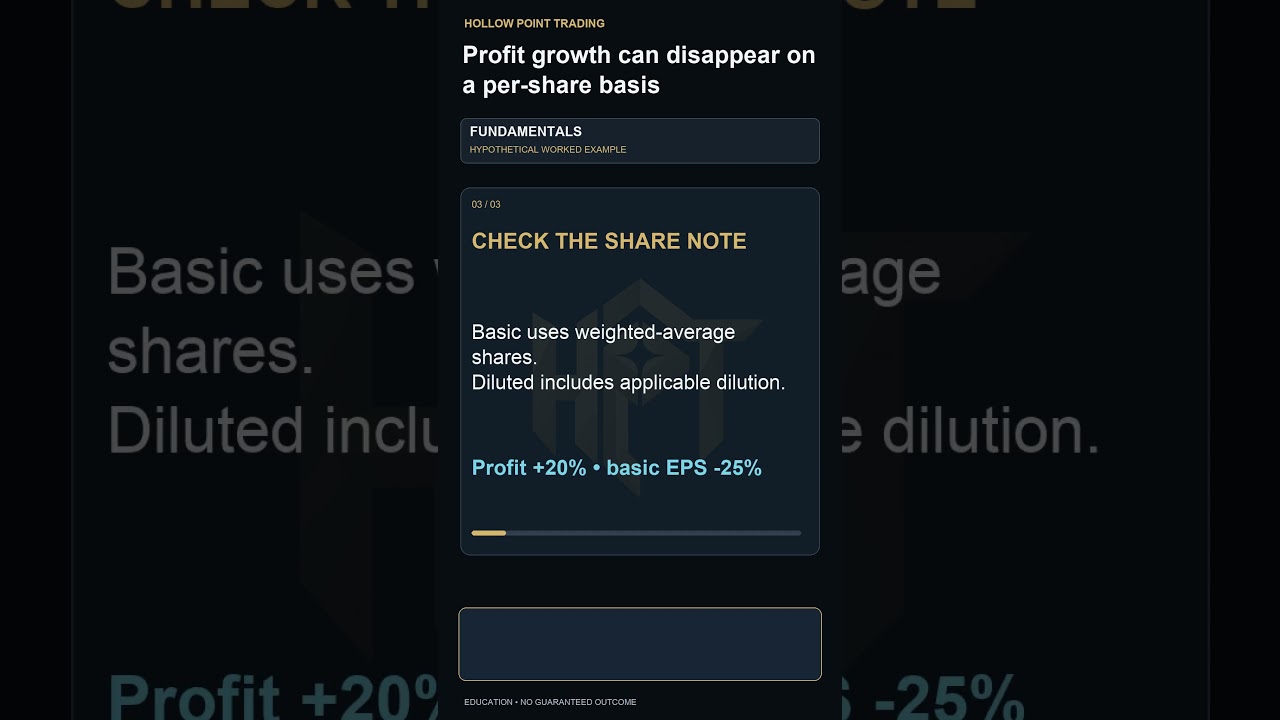
A company can earn more while each share earns less. In a hypothetical year, income available to common shareholders is ten million dollars, with five million weighted average common shares. Basic earnings per share is two dollars. Next year, common earnings rise to twelve million dollars, but weighted average shares rise to eight million. Basic...

Why Profit Growth Can Shrink Earnings Per Share

Capital Intensity and Free Cash Flow Explained

https://youtu.be/rjWb-AGFgzs

How capital intensity changes cash generation #Shorts


Two businesses can produce the same operating cash flow and leave different amounts after equipment spending. In a hypothetical year, both generate twenty million dollars from operations. Business A spends five million on property and equipment. Business B spends fifteen million. Subtract those purchases from operating cash flow. The simplified ...

Capital Intensity and Free Cash Flow Explained

Core Inflation Explained: What It Excludes

https://youtu.be/O7YS45iPFCA

Core inflation excludes categories not household expenses #Shorts


Core inflation does not mean food and energy stopped costing money. The consumer price index for all items includes those categories. A commonly reported core index excludes food and energy to examine price changes outside those relatively volatile components. Imagine a simplified basket with eighty percent weight outside food and energy and twe...

Core Inflation Explained: What It Excludes

Why a Pay Raise May Not Boost Purchasing Power

https://youtu.be/cvLkBvs4eHk

A pay raise can still leave purchasing power lower #Shorts


A pay raise measures dollars, not automatically purchasing power. In a hypothetical year, annual income rises from fifty thousand dollars to fifty two thousand. That is a four percent nominal increase. Suppose the relevant consumer price index rises five percent over the same period. Divide the new income by one point zero five to express it in ...

Why a Pay Raise May Not Boost Purchasing Power