Master Crypto Influencer Marketing and Web3 Community Building: A Practical Playbook
Summary
In Web3, community and marketing are inseparable. This playbook turns KOL categories, creator outreach workflows, and Discord engagement into a repeatable growth system.
In Web3, you can’t fully separate “marketing” from “community.” The discussions in this live session emphasize that early growth starts by building a place where people can engage—then scaling through careful creator and KOL strategy backed by feedback and measurable signals.
Below is a practical, evergreen playbook based on the transcript summary: how to plan crypto influencer marketing, structure community efforts, choose KOLs using the right metrics, and keep communities active after the campaign ends.
Crypto influencer marketing + community building: “the community is your livestream”
The core theme is that community isn’t a side initiative—it’s the growth engine.
At launch, community often comes first because you need an initial base of people (“from somewhere”) to build momentum and create ongoing interactions. In the session, community growth is framed like starting and feeding a fire: early supporters provide the first ignition, then you add “fuel” through organic targeting and trusted partnerships.
A key operational point: community members don’t just react—they critique. Those interactions can become a structured feedback loop that informs brand and product direction.
Community vs marketing at launch: build first evangelists using the fire/bonfire model
The session treats marketing and community as “one and the same” at the beginning. Instead of attempting broad promotion immediately, teams should:
- Start with existing relationships, experience, or events to create an initial audience.
- Grow organically through targeting (not spam).
- Prioritize persistence: early evangelists can become the most influential voices over time.
This is also why communities like Discord are described as especially powerful for Web3 projects: early members frequently become elite contributors or volunteers, and their continued participation amplifies the project.
The community feedback loop: using engagement as product + brand signals
Community is described as a “stepping stone” in Web3: it spreads messaging while also producing continuous feedback.
In the transcript summary, community members are positioned as some of the biggest critics—constructively identifying weaknesses in business models and shaping how the project is presented.
To make this actionable, measure patterns in the feedback you receive. Repeated user input becomes a signal to change what you build or how you communicate.
KOL strategy in Web3: categories and why engagement + recency matter
A major portion of the session focuses on KOL/Ks selection using categories and the right metrics.
Instead of thinking of influencers as a single group, the session groups KOLs into three types:
1) Engagement KOLs
These creators or accounts drive organic, two-way conversation—especially on Twitter—where comments are meaningful and interactive.
2) Volume-based KOLs
These KOLs may have lower engagement but create strong “buy pressure” signals. They often coordinate through Telegram/Discord and may run calls.
3) Profile KOLs
These are influential profiles (e.g., exchange CEOs, major project founders, influential communities). Consistent collaboration can create an “omnipresence” effect that improves outreach outcomes.
The selection principle: engagement and recency over follower counts
The session explicitly warns that subscriber counts can mislead. Selection should emphasize:
- Engagement and recency of engagement
- Whether the audience is still active and interacting
If a KOL’s engagement quality has fallen, you may be paying for visibility that no longer translates into real community activity.
Budgeting and channel selection: plan using objectives and “the right customer”
The session discusses two practical ideas: (1) budgeting must tie back to the customer, and (2) channel choices should match trust-building versus distribution needs.
Use a customer-first budgeting mindset
A statement in the transcript summary ties budgeting to the customer themselves. Another point frames spend as something that should be justified by outcomes, not simply “throw money on the fire.”
Additionally, the transcript summary notes a guideline for marketing allocation:
- Roughly 20–30% of the overall raised budget to marketing (potentially higher for less technical projects)
Apply a four-part filter
Budget decisions are guided by a “four-part filter”:
- Right product
- Right timing
- Right funding
- Right team
Channel strategy: Twitter, Telegram, Discord, and YouTube for trust
For distribution and ongoing community interactions, the session emphasizes:
- Telegram
- Discord
For trust, YouTube is highlighted as especially useful for evergreen content and building familiarity—particularly when retail interest returns.
Creator outreach pipeline: build a repeatable system (not ad-hoc DMs)
The session argues for process-driven outreach.
Start with an outreach person (and include the conference/pipeline angle)
Outreach should not be limited to finding creators. The transcript summary stresses that early-stage teams benefit from an outreach person who can also identify conferences and partnership opportunities.
Avoid the “agency wall”—keep communication direct
A key criticism in the summary: agencies can create a barrier that prevents direct communication with creators, which reduces creator engagement and emotion.
Suggested team structure: KAM + analytics support
The session proposes a structure like:
- KAM (key account manager) to build and maintain creator relationships
- Data/analytics support to inform targeting and measurement
Outreach messaging: be human, concise, and respectful
Because creators receive heavy spam, outreach should be:
- Clear and concise
- Respectful (“it’s about making sure that you respect everyone”)
- Not generic
Some teams may include a listed budget/price to reduce friction.
Follow-ups matter
The summary includes follow-up when creators miss messages, especially given creators’ limited attention.
Campaign pipeline: vet KOLs with KPI checks and keep lists clean
A reliable campaign depends on vetting and continuous monitoring.
Build your initial audience and vet against criteria
The session describes building an audience using creator/reviewer profiles, then using cues tied to metrics.
Review and refinement before onboarding
There’s a process stage before moving from sourcing to onboarding, including refinement and approval.
Ongoing health checks and list cleaning
After onboarding, teams should:
- Monitor campaigns continuously
- Perform weekly “health checks”
- Clean lists over time
If a KOL no longer meets the criteria, replace them. The summary notes that occasional downturns can be handled with some leniency.
The consistent goal: ensure KOL partners still match your criteria rather than assuming they remain suitable forever.
Ambassador programs and community-driven amplification
The session also covers a VIP ambassador approach.
In the summary, an ambassador program is positioned as an official initiative alongside the brand—something creators want to join. Typical benefits include a VIP group and networking with other ambassadors.
From there, amplification is community-driven:
- Boost ambassador posts
- Retweet and engage across ambassador content
This is intended to create a “flywheel” where community participation increases visibility, and visibility brings more participation.
Timing and creator count: start early and treat collaborations as discovery
The summary recommends starting outreach well before a launch.
In a bull market, time is scarce for creators, so teams should build ahead rather than expecting fast results.
A specific guidance in the summary: if you want to work with creators now and launch in about two months, begin building the campaign now.
Also, running just one or two collaborations may not be enough. Instead, treat creator work as discovery—testing which messaging and creator types resonate.
Suggested ranges for creator campaigns (as given in the summary)
- Target at least 5–10 creators (potentially 10)
- Multiple platforms may require different volumes (e.g., more Twitter volume than YouTube)
Measuring marketing outcomes: set expectations and avoid a “no silver bullet” mindset
The session explicitly rejects the idea of a single “silver bullet.” Success typically requires multiple tactics.
Marketing budgets and expectations should be tied to measurable outcomes, such as:
- Downloads
- Community growth
- Token acquisition (in token-focused campaigns)
The summary emphasizes measurement and the importance of not simply “throwing money on the fire.”
Keep communities active after marketing ends: activity breeds activity
Community retention is addressed directly: how to reduce bounce and keep meaningful activity going once influencer marketing stops.
Make activity visible
The session states that people join and stay when they see visible activity. Inactivity can signal lower value and increases bounce.
Add participation mechanisms
To drive continued engagement, include participation mechanisms such as:
- Events
- Games
- Live voice chats
Human moderation matters
The summary recommends human moderation and responsiveness. AI may attract curiosity, but it can go off-topic or produce disruptive content.
Don’t spread activity too thin
A clear tactical warning in the summary: avoid having too many channels where activity is scattered (e.g., “30 different channels”). Consolidating active participation helps keep discussion sustainable.
Discord channel focus and tooling: start with 1–3 key channels
To keep community operations manageable, the summary recommends focusing on:
- One to three key Discord channels
It also suggests a must-have vs nice-to-have decision process to determine what to keep and what to remove.
Additionally, the summary notes that community features from other platforms can be integrated when they solve similar needs.
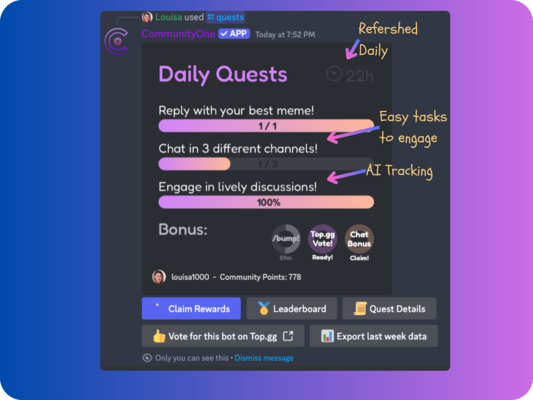
The session also mentions choosing community tooling with intent (example tool mentioned in the summary: Community1) when it supports community building and engagement.
Marketing readiness: set objectives, hire or outsource if needed, and listen to feedback
If marketing isn’t your comfort zone, the summary advises not to delay indefinitely. Instead:
- Hire experts or outsource community/influencer work.
- Set clear objectives.
- Allocate a budget.
- Ensure you have the team/resources to execute.
Finally, relationship-building matters. The session emphasizes listening across conversations and making logical, safety-conscious decisions.
Conclusion: build a Web3 growth system that combines creators + community
The playbook from the session can be condensed into a simple system:
1) Start the community early so marketing has an actual “place to land.”
2) Use KOL categories (engagement, volume, profile) and select for engagement quality and recency.
3) Run outreach through a pipeline with clear, respectful messaging.
4) Vet and monitor KOLs with KPIs, keep lists clean, and replace partners when criteria drift.
5) Keep communities active after marketing with visible participation, human moderation, and focused channels.
When community and influencer strategy are managed together—backed by feedback and measurement—Web3 projects can scale with real engagement instead of chasing noise.