


Building with Neo4j Relate: NorthWindPLUS Use Case
Sharing an interesting use case for Relate: https://github.com/Flyer-Boy/NewApproach/tree/main/NorthWindPLUS/Neo4jRelate - I hope you like it.

Sharing an interesting use case for Relate: https://github.com/Flyer-Boy/NewApproach/tree/main/NorthWindPLUS/Neo4jRelate - I hope you like it.
testing webhook
Hey guys I have been searching for these repos, where we supposed to find them on our own, or where they supposed to be installed automatically after
curl -sSfL https://relatedb.ai/install.sh | bash
command
I am confused here
Hey guys! Anudeep this side. I'm working on building code graphs helping any AI powered software comprehension tasks. Excited and interested to learn more from the community
this is gold, especially the isolation part. are you running multi-tenant in one db with labels, or separate databases per domain? the leak prevention bit sounds like the thing people underestimate
Interesting use case! I think it's a perfect fit for the graph data model. Any challenges so far?
Documentation specify that new bolt version is out https://neo4j.com/docs/bolt/current/bolt-compatibility/
But when I try it I'm getting Connection closed by remote host right away and in Neo4j log is no information at all. If I try to connect to Neo4j 2026.09 with Bolt 6.0, it works as expected.
What can be the issue?
Hello,
I'm running a query from the listing 3.18 of https://www.manning.com/books/knowledge-graphs-and-llms-in-action
MATCH path1=(n:HpoPhenotype)<-[:SUBCLASSOF]-(m:HpoPhenotype) WHERE n.label = "Diabetes mellitus"
WITH path1
MATCH path2=(i:HpoPhenotype)<-[ :ANNOTATEDSOURCE]-(j)
WHERE i.label in ["Diabetes mellitus", "Type I diabetes mellitus"]
WITH path1, path2, j
MATCH path3=(j)-[:ANNOTATEDPROPERTY|HASSYNONYMTYPE]-()
RETURN path1, path2, path3;
In the book, this gives a colour-coded graph with two different node colours. But I see that Resource labels' colour overrides Axiom label colour, and everything looks green in Neo4j Desktop.
How do I make the graph visualisation look like in the book?

Hi, I am going on with my project, developing a local AI environment using Graphs for a model that reasons about history and theories.
I am using now a local instance of Neo4j Desktop and the Neo4j LLM Graph Builder.
I have complete the course that recomended me (Building Knowledge Graphs with LLMs).
Now I am thinking into integrated LangChain and LangGraph to implement a React Agent to translate querys and construct knowledge about new oriented investigations.
Also I am guessing if SpaCy couldn be usefull for accurately extract linguistic roots or words from ancient languages around my corpus texts such as Elengoa (a precursor to the Basque language).
Could someone point me in the right direction for the next steps? About how to integrate LangChain and LangGraphg and learn about Agents to create reasonable claims to create new knowledge node graphs.
Thanks in advantge!
Hey, what are you building with Neo4j?
I have a website, I want it better, lmk if you can help
So the human connectivity one would have to be, a trillion times more complicated?
Hi All,
We are developing an enterprise-grade clinical pedigree and generational health platform. We transform multi-generational family medical histories into interactive property knowledge graphs (powered by @Neo4j) to identify hereditary disease risks—including familial cancers, cardiovascular diseases, and Mendelian traits—decades before clinical onset.
Platform Showcase & Interactive Demo:
URL: https://www.idilehealth.com/tree/demo
Idile Health is a global clinical pedigree and family health intelligence platform designed to eliminate diagnostic delays in hereditary disorders and non-communicable diseases (NCDs) worldwide.
Key Capabilities Demonstrated in the /tree/demo Sandbox:
demonstrates how graph representations can optimize RAG systems by providing structured context across disparate data sources. Attendees explore three key data shapes—connections, table of contents, and themes—to improve agentic reasoning and query accuracy when working with complex document stores and SQL warehouses.
How this was madeYour agent can reach your data and still get it wrong. Vector search hands it a slice, Text2SQL hands it another, and neither tells it what is actually relevant or how the pieces connect, so the answer comes back confident and wrong. Zach Blumenfeld's argument in this hands on workshop is that the missing piece is not a better model or a better query. It is context, and context comes in shapes.
He builds three reusable graph shapes on top of lakehouse data with Neo4j, each answering a question the agent cannot ask a table. Trees give a table of contents, so the agent can navigate what is even there. Communities surface themes, the patterns nobody named. Paths and cycles trace connections, how entities, documents, and records actually relate. The shapes are portable to BigQuery, Databricks, or Snowflake, and you leave with the code to run them on your own data and agents.
Speaker info:
/ zachblumenfeld
https://graphacademy.neo4j.com/course...
Timestamps:
0:00 - Introduction: context comes in shapes, not queries
6:25 - The three graph shapes to build
10:56 - Environment setup: Codespaces and Neo4j
21:47 - Schema, shared terms, and join paths
45:25 - Shape 1: a table of contents for your data (trees)
50:30 - Building the containment tree and links
59:48 - Serving the graph to the agent over MCP
1:12:21 - Q&A: naming and the containment shape
1:22:54 - Shape 2: surfacing themes with communities
1:24:24 - Community detection with Leiden
1:31:09 - Hierarchical communities and naming themes
1:43:22 - Shape 3: connections and cross links
1 20 - Watching the agent use outlines and themes
1:55:05 - Wrap: theme types and real time linking
Running with the image neo4j:2026.08.1-community-trixie
sfarnsworth@myvm:~/project$ gunzip -c ./data/foo/HAS_AUTHOR_rel_header.csv.gz
:START_ID,:END_ID,:TYPE
START_ID,END_ID,TYPE

sfarnsworth@myvm:~/project$ gunzip -c ./data/foo/HAS_AUTHOR_rel.csv.gz  | head -n 3
START_ID,END_ID,TYPE
af8,af8-0,HAS_AUTHOR
f1d,8f1d-1,HAS_AUTHOR
Then I run this
'bin/neo4j-admin database import full '
'--dry-run=true '
'--path-pattern-style=glob '
'--nodes=Document=import/Document_node.csv.gz,import/Document_node_header.csv.gz '
'--nodes=Person=import/Person_node.csv.gz,import/Person_node_header.csv.gz '
'--relationships=HAS_AUTHOR=import/HAS_AUTHOR_rel.csv.gz,import/HAS_AUTHOR_rel_header.csv.gz '
And I get this
WARNING: Using incubator modules: jdk.incubator.vector
Neo4j version: 2026.08.1
Checking the contents of the following files:
Nodes:
  [Document]:
  /var/lib/neo4j/import/Document_node.csv.gz
  /var/lib/neo4j/import/Document_node_header.csv.gz

  [Person]:
  /var/lib/neo4j/import/Person_node.csv.gz
  /var/lib/neo4j/import/Person_node_header.csv.gz

Relationships:
  HAS_AUTHOR:
  /var/lib/neo4j/import/HAS_AUTHOR_rel.csv.gz
  /var/lib/neo4j/import/HAS_AUTHOR_rel_header.csv.gz


Available resources:
  Total machine memory: x
  Free machine memory: x
  Max heap memory : x
  Max worker threads: x
  Configured max memory: x
  High parallel IO: x

- ----------------------------------------------------
Command Failed
Error importing csv file.

Missing header of type START_ID, among entries [START_ID, END_ID, TYPE] in '/var/lib/neo4j/import/HAS_AUTHOR_rel.csv.gz'
I'm not sure how either HAS_AUTHOR file could possibly be wrong given my read of the documentation.
I have this
MATCH (source:ResolvedEntity)-[r:RESOLUTION]->(target:ResolvedEntity) WHERE r.confidence = "POSSIBLY_SAME"
WITH gds.graph.project('super_resolved_orgs', source, target) AS g
return g
I then want to get all the components in this projection, but I'm worried that since r is not actually used in the project function, other relationships might end up in the projection. Can someone help me understand the semantics?
I'd love to hear how people think about designing the right data structure for this problem.
We have a high-traffic website. For each visitor, I can collect things like:
ASN, IP address, user agent
Number of pages visited, and which actions they took
Retention signals — how often do they come back, and when do they show up?
Given that IP A shows up, what's the probability IP B shows up immediately after?
So: fairly standard web traffic telemetry, all stored in sql db.
Now the problem is that a meaningful share of this traffic is bots, and we are not sure how to systematically detect them.
The issue is compounded by the fact that the bots are adaptive. When you block one behavior, they don't disappear — they mutate. For example, we put up a Cloudflare challenge one day, and an entire cluster vanished overnight. But it didn't stay gone; it came back with a different strategy. Where the group previously ran many actions per IP, it switched to one action per IP across a much wider IP pool.
In other words, the features that identified the group are exactly the features they change once you act on them. Any schema I build around today's signature seems to have a short shelf life.
Would love to get some thoughts on:
(1) How would you model this, or add data structure to it: entity-centric (per IP / per fingerprint), session-centric, or graph-based (IPs, ASNs, UAs, and behaviors as nodes with co-occurrence edges)?
(2) What's the right way to represent time, given that the same actor persists across identifier changes?
(3) How do you version or structure the data so that your labels and features survive an adversary that reacts to your defenses? (Related: how do you keep a record of "this cluster died the day we deployed X" as a first-class signal rather than a footnote?)
(4) Are there established patterns here — entity resolution, behavioral fingerprinting, graph clustering — that I should be reading up on before I invent something worse?
Hi I’m looking for some guidance on fine-tuning a model for Text-to-Cypher.
I’ve been fine-tuning Qwen3-4B using Unsloth and currently getting around a 41% success rate. For evaluation, I’m using the Neo4j Text2Cypher dataset, where the model receives the graph schema + natural-language question and predicts a Cypher query. I then execute the predicted query against Neo4j, and if it produces the correct result, it’s counted as a success.
I’ve experimented with different volumes/versions of my synthetic training dataset, but I’m struggling to get the performance beyond this point.
Would really appreciate any guidance on dataset preparation, fine-tuning strategy, or common pitfalls for this kind of task. Thanks!
Hey I’m super new to neo4j/graph db in general and I’m trying to automate my mostly repetitive job. Not completely repetitive but I’m certain it can be automated although a knowledge graph would help it improve upon itself. I’m super lost on where to start, I watched a YT video where you feed Karpathy’s gist to Claude and make an obsidian set up but the routing is a mess. Were not cleared to use neo4j at work (financial services, sensitive data) but am interested in general graph concepts. Don’t know where to start!!
I am working on OO flavoured modelling for graph DB, having fleshed out that using abstract classes and inheritance of properties through taxonomical cascades, as well as relationship inheritance alongside these, purely graphical notation conventions and a fixed protocol to transfer the model to an actual Neo4j DB while importing (or entering) instances is a very plausible strategy for those migrating to graphs from relational approaches and, above all, for newbies in database design 🙂
Would really welcome comments on this !!
Hi , can i be able to recover data from a suspended aura instance that was on trial period? Currently it is scheduled for deletion.
Agentic Medical Diagnosis System With Hierarchical Knowledge Graphs Built on Neo4j
I've built Agentic GraphRAG for Medical Diagnosis (https://github.com/avnlp/agentic-med-diag), an end-to-end system combining a schema-driven Neo4j knowledge graph with LangGraph orchestration, multi-strategy vector search, hybrid retrieval (dense + BM25), and an agentic plan–research–verify loop for evidence-grounded clinical QA.
Neo4j architecture:
- Typed property graph with 5 node labels (Document, Chunk, Entity, Community, CommunityReport) and 7 edge types
- Schema-driven entity and relation extraction with union/intersection/max-score combination strategies
- Deterministic SemHash/MinHash pre-filter + clustering for two-stage entity resolution
- Hierarchical Leiden community detection (Graspologic + Neo4j GDS backends)
Knowledge Graph Construction
Layered Retrieval Architecture
Agentic Plan–Research–Verify Loop
The stack is battle-tested: Neo4j + Weaviate/Qdrant for storage, LangGraph for orchestration, DeepAgents for multi-agent coordination, and BAML for type-safe LLM schema injection. Tested on MedQA, MedXpertQA, MedCaseReasoning, and MMLU-Pro benchmarks.
I have been using aura db since past 3 years. In the month of January 2026, i had run the python code to connect to my database on aura db.
Yesterday, I tried to run the code to connect to the database using python using the same credentials I had used before. Since then I have never changed the password. Now I am unable to connect to the DB. The connection failed with error : "AuthError: {neo4j_code: Neo.ClientError.Security.Unauthorized} {message: The client is unauthorized due to authentication failure.} {gql_status: 42NFF} {gql_status_description: error: syntax error or access rule violation - permission/access denied. Access denied, see the security logs for details.}"
Please help to resolve this issue. Thank you!
Hi Neo4j team,
Urgent paid-tier Aura issue. I deleted my paid AuraDB Professional instance and downloaded a snapshot backup but it somehow corrupted. I need to restore it / recover the latest snapshot before the 7-day window closes. Also being charged (~$700) for the now-deleted instance. As a feature request, would love to be able to set a budget.
Can a staff member point me to the fastest path? I have my instance ID + account details ready to share. 🙏
Hi guys! I just created an action orchestrator for any app (that follows its protocol), the goal is to grow the ecosystem and let developers register their own app's "actions", then use the framework to orchestrate workflows involving different apps with actions.
It has its own schema language: HSchema
and its own scripting language: HScript (code example below)
workflow grade_pipeline() -> printer::Printed
errors {
grade-list::GradeError
mean-calculator::MeanError
printer::PrintError
}
{
let grades = grade-list/get()
let mean = grades
    |> as mean-calculator::MeanInput
    |> mean-calculator/calculate()

return mean
    |> as printer::PrintInput
    |> printer/print()
}
This pipeline orchestrates actions from 3 different apps (grade list, mean calculator and printer), and generates one continuous workflow.
The framework doesn't know anything about the app, or perform any business logic for the app's action. It simply calls the actions from each app, and the apps perform them internally.
It's completely open source, low level and I intend to add better compatibility to more programming languages.
Currently only works on Linux, but I will work on Windows and MacOS too.
The goal is that, when the project is mature enough, agents can use HScript to automate complex multi-app tasks very fast. It supports some level of concurrency and parallelism too.
Github repo:
https://github.com/EduardoManduca/Hermas

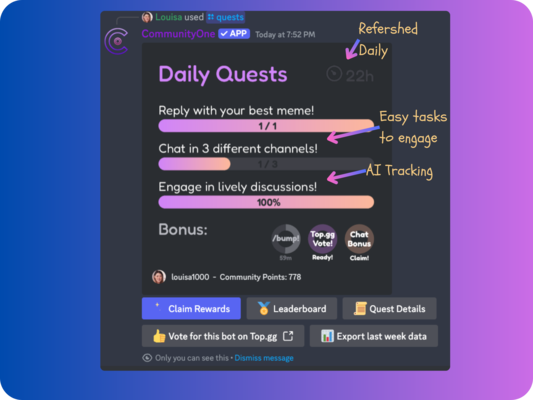
Daily smart quests: 4x messages & free AAA games
Be the first to know when Spark Tickets launches
Be the first to know when Spark with Tickets launches
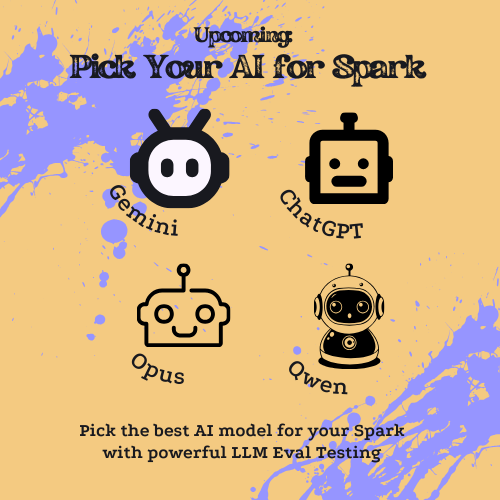
Be the first to know when Community Monetization launches
Be the first to know when X Integration launches


With your permission, make your Discord community discoverable on Google. Automatically index your events and announcements for better visibility.



External Link
Platform
You are about to visit:
https://example.comThis will open in a new tab. Make sure you trust this link.