Best Discord Bots for 2025: Moderation-First Checklist (Plus Music, Tickets, and Fun)
Summary
A moderation-first framework for choosing the best Discord bots in 2025, with vetting tips and curated picks for large servers, tickets, invites, music, and fun.
Discord bots can make a server run smoother, but the best results come from choosing them in the right order. In 2025, the “moderation-first” approach is the most durable strategy: build foundations for safety and reliability first, then add utility, and only then consider music or fun.
Below is a practical checklist based on the video’s 2025 bot-selection framework, including what to look for and specific bot recommendations for common server needs.
Discord Bot Selection Framework for 2025 (Moderation First, Fun Last)
Start with moderation bots before you add any “lively” features.
1) Build the moderation foundations
Before you focus on entertainment, prioritize tools for:
- Banning bad behavior or violating content
- Timeouts/mutes
- Welcome logs and other logging
- Reliable moderation actions and records
The key idea is that “fun bots or bots that could make your community look extremely lively” come after you’ve made moderation workable.
2) Match the bot to your server’s purpose and size
Not every “popular” bot fits every server. The video recommends choosing based on:
- What your community is for (commercial vs social; RPG vs support-driven communities)
- How large your server is
- Whether the complexity of configuration is worth it for your audience
There are tradeoffs: more powerful systems can be more complicated, and attention is limited—too many bots and channels can leave content idle.
3) Use a data-driven way to shortlist bots
Instead of relying only on lists, the video suggests checking:
- Popularity on platforms like top.gg
- Actual adoption signals and in-server usage (including message activity)
4) Decide what the bot should never replace
Bots are supplementary. The video emphasizes that they cannot replace human involvement. Even with “no bots are magical” expectations, you still need to be present and engaged consistently.
How to Vet Discord Bots (So You Don’t Pick Ones That Disappear)
Before installing a bot you haven’t used before, evaluate it like software—not like a one-time tool.
Check whether the developer is actively managing the bot
Look for signs the bot is maintained and supported:
- Frequent updates
- GitHub activity
- A way to contact the developer for support
The video warns that “bots they come and go.” If you’re going to give a bot a good chance, you should be able to reach its team.
Consider scalability for large servers
For bigger servers, scalability matters because high activity can reveal limits. The video mentions the risk of missing data and discusses this kind of concern in the context of tracking and peak server events.
A practical takeaway: confirm that the bot can handle your busiest periods without losing important logs or actions.
Evaluate configuration complexity vs your needs
Some moderation tools are powerful but complicated. The video’s example is YAGPDB: great for strict, specific rule-building, but not always necessary if you don’t need that level of detail.
Best Moderation Bots for Large Servers
For large servers, moderation needs go beyond basic automod. Two recommendations stand out.
YAGPDB for advanced moderation rules
YAGPDB is highlighted as a strong moderation choice for very large servers because of extensive customization.
Key capability: it supports an “advanced auto mode” that allows complex regex-based moderation rule creation.
Important caveat from the video: because YAGPDB is complicated, it may be unnecessary unless you need strict, specific behavior rules (for example, themed or RPG servers).
Zeno as “insurance” for extreme needs
Zeno is described as useful for “extreme end” needs, especially when you care about recovering quickly.
It includes:
- Community templates for making servers look cleaner
- Role management automation
- Backup/restore coverage, described as a kind of insurance after destructive events (for example, nukes)
If you’ve ever dealt with large-scale chaos, this “restore” mindset can be more valuable than pure automation.
Community & Utility Bots: Welcome Logs, Tickets, Invites, and Roles
Moderation is the base layer. Then add bots that support growth and day-to-day operations.
Welcome messages and logging: Probot and Dino
The video calls out specific utility patterns:
- Probot for customized welcome message setups (including the ability to design randomized greetings and banners)
- Dino as a favorite for reliable logging and scalability of recorded events
Even though logging is common across many bots, the emphasis here is reliability.
Ticket bots: Ticketing over Ticket King
When choosing ticket bots, the video compares two major options:
- Ticket King
- Ticketing
The recommendation is to prefer Ticketing, especially at higher ticket volume.
Why: Ticketing is described as easier to manage when many tickets are open (the video references scenarios like 500 tickets). It also focuses on closing workflows using features like auto-close and auto-remind.
Referral invite security with verification
The video advises against rewarding members purely based on invite count.
Reasons:
- It encourages low-quality bot joiners
- It can undermine server quality
Instead, use a verification bot to reduce abuse (the video references Vickbot as an example of quarantining users who join too fast).
For rewards, the video recommends measuring both:
- Quantity (top invites)
- Quality (higher quality invites using analytics like message activity)
It also recommends keeping quality criteria somewhat vague to reduce gaming, while still explaining the basis at the end of the campaign.
Music Bots and “Fun Bots” in 2025: Use Them to Support Engagement
Music and fun are heavily searched categories, but the video frames them with a strong constraint: they should support community energy rather than replace it.
Music bots: enable “listening together”
The magic of a music bot is not just background audio—it’s that people listen together.
The video also notes that watch together moments can happen through Discord live streams without a bot, but bots can still help when configured properly.
Recommended picks mentioned:
- RhymeCore for smaller servers with casual music/chat moments
- Rythm for large groups, using a style aligned with Discord’s more public activity behavior
The video cautions not to overestimate how much music bots alone drive activity. For growth, it suggests watch parties that involve humans.
Fun bots: best during downtime
Fun bots work best when there’s a gap between active moments—when the server needs something to keep momentum.
The video emphasizes that the most effective engagement method is the server owner or staff talking to users.
Fun bot guidance:
- Use fun bots during downtime between active moments
- Avoid building the server around a single bot
- For beginner servers, start with one fun bot rather than many
Fun bot examples mentioned include:
- Dank Memer
- Akinator (guessing game)
- Taco Shack
Tickets, Roles, Points, and Leaderboards: Rewards Need Care
If you use bots for ranks/roles, points, or leaderboard-style rewards, the video stresses careful design.
Points and what they mean
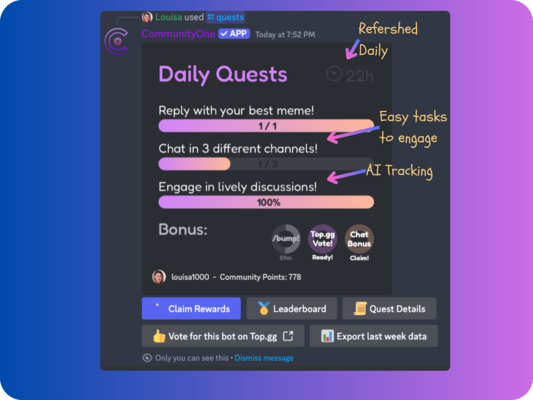
Points can be awarded automatically, but you must define what points represent for your community (they act like currency).
Ranks vs roles
The video distinguishes:
- Ranks: can be automatic at level thresholds
- Roles: can be redeemable after users spend points
Leaderboards require reset planning
Leaderboards can reduce participation if users feel they can’t catch up.
The video’s guidance: if you do leaderboards, allow resets so new or returning users don’t feel locked out. It also provides an example of low participation when weekly quests near the end of the week didn’t provide enough opportunity for users to overtake existing leaders.
Conclusion: The Best Discord Bots Are the Ones That Match Your Server (and Your Time)
The “best Discord bots for 2025” aren’t the ones with the most hype—they’re the ones that:
1) Handle moderation foundations first (bans/timeouts/logging/welcome logs)
2) Are actively maintained and scalable for your size
3) Add utility (tickets, reliable logging, invite verification)
4) Support engagement rather than replace human involvement
If you follow that order—moderation → utility → music/fun—you’ll end up with a server that feels safer, runs better, and stays engaging without turning the community into a bot playground.