Why Accurate Trading Signals Can Still Mislead
Summary
Hollow Point Trading shares a short video explaining the base-rate problem: when an event is rare, even a detector that catches nine out of ten events can generate many false alarms. In the example, ten true events and roughly ten false alarms produce nineteen alerts, showing why traders should consider base rates alongside apparent signal accuracy.
https://youtu.be/3KC7OZcpShI
The base-rate problem in a perfect-looking signal #Shorts
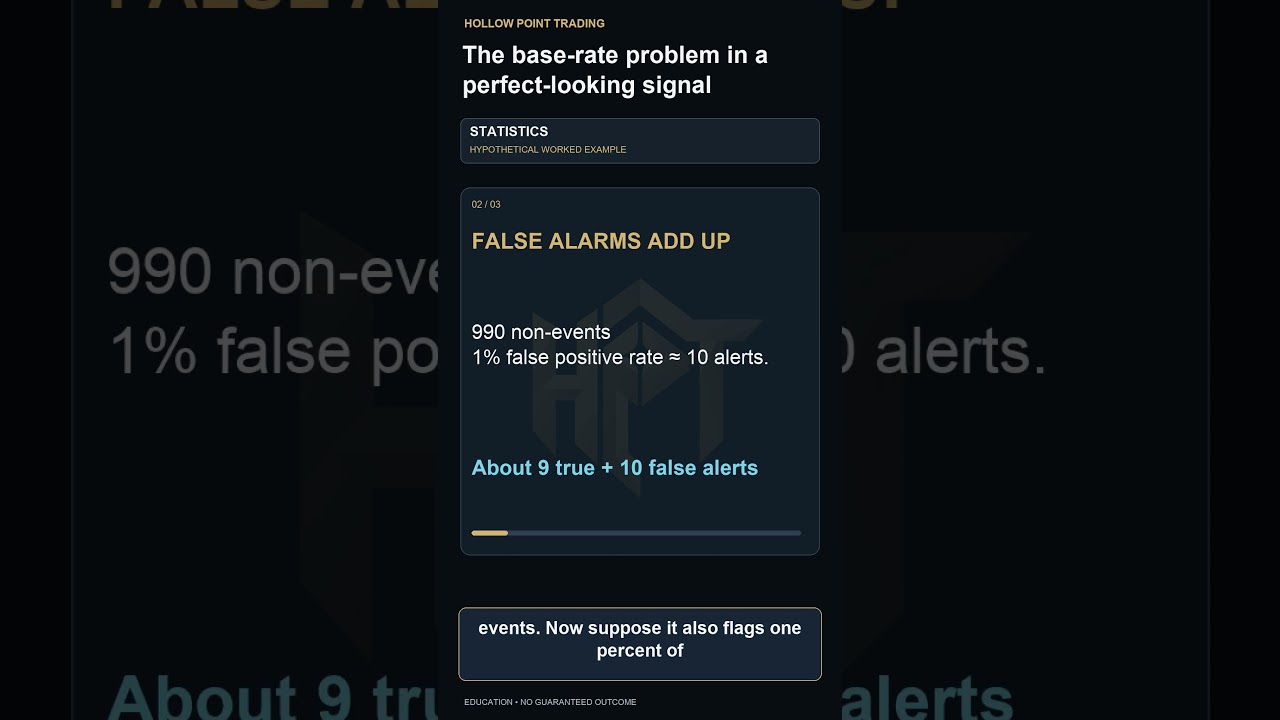
A signal can look accurate and still produce many false alarms when the event is rare. Imagine one thousand cases, with a real event in only ten of them. A detector catches nine of those ten events. Now suppose it also flags one percent of the nine hundred ninety non-events, roughly ten false alarms. You receive about nineteen alerts, but only n...











