Choosing Discord bots in 2025 shouldn’t start with what’s trending. The smartest approach is to build a server that runs well first—especially for moderation, onboarding, and safety—then add utility and engagement features that support your community.
This guide is based on a step-by-step bot philosophy: moderation first, special-purpose bots next, and “fun” bots last.
How to Choose Discord Bots: Moderation, Special Purpose, Then Fun
1) Start with moderation bots (even before “fun”)
The transcript’s core recommendation is simple: moderation bots come first. For many communities, “moderation” isn’t only banning rule-breakers—it can also include logging so moderators can review what happened.
This matters because a bot that adds games, music, or automation won’t help if spam and rule violations aren’t handled reliably.
2) Add special-purpose bots based on your server type
After moderation, choose bots that match how your community actually works. The transcript frames bot selection as “special purpose by server type,” such as:
- Community style (commercial vs. social)
- Use case (RPG rules vs. support-driven channels)
- Your moderation workflow (what needs automation vs. what needs staff oversight)
In other words, don’t build a random bot list—build a stack that supports real server workflows.
3) Use fun bots as support, not the foundation
The transcript emphasizes that bots should support engagement during downtime—not replace human conversation and presence.
It also suggests keeping the number of fun bots controlled, especially for beginners. If you’re running a smaller community, start with one fun bot at a time to avoid confusion and overlap.
How to Evaluate Discord Bots: Updates, Support, and Scalability
Installing a bot is not the same as having a bot that actually works in your server.
Check developer support and updates
When trying a new bot, verify that developers actively manage it. Look for:
- Regular updates (including on GitHub, if applicable)
- Active Discord support and timely responses
- A clear way to contact the team if something breaks
The transcript also notes that bots can “come and go,” so having a way to reach the developers is important if you rely on the bot long-term.
Consider scalability limits (especially on large servers)
The transcript warns that some bots may miss tracking if a server is extremely busy. So, before relying on analytics, logging, or any event-based automation, evaluate how the bot performs under real load.
In very large servers, this becomes a practical selection criterion—not a theoretical one.
If you want an all-in-one moderation option
The transcript specifically mentions Sapphire as a comprehensive “one bot” approach. It includes moderation-style functionality such as:
- Automod
- Welcome logs
- Bans/timeouts/mutes
- Logging
It’s also described as “almost 100% free” and includes AI moderation and other features (including beta moderation tooling and rate limits). The main takeaway is that it’s positioned as a core moderation hub.
Best Utility Bots (2025): Welcome, Logging, Levels, and Surveys
Once moderation is covered, utility bots help your server run smoothly for newcomers and ongoing community engagement.
Welcome messages and onboarding
- Probot is highlighted for welcome message customization, including a dashboard and options like banners/colors and randomized text.
If you want more than a basic “welcome” line, Probot is presented as a strong option.
Logging you can trust
- Dino is recommended as a favorite logging bot, with a focus on reliability and scalability.
- Vic is also mentioned as another security/logging-related option.
Logging is important because it supports moderator review and helps connect moderation actions to what users actually did.
Reaction role automation
- Carbot is positioned primarily for role assignment through reactions.
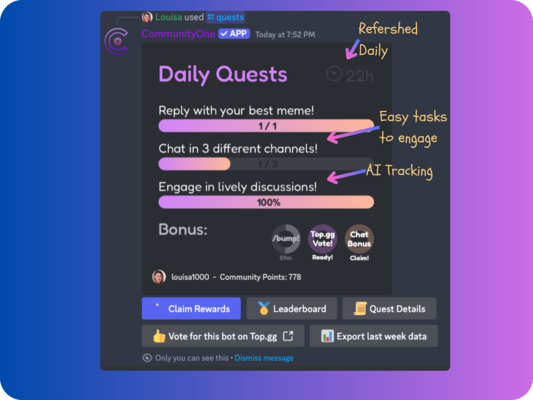
Leveling and points (with a realism check)
For progression systems, the transcript suggests:
- Arc and Unbelievabo for chat-based progression and customization.
However, it includes a caveat: leveling systems can encourage robotic chatting without real engagement. If you use points, make sure your server culture still rewards meaningful participation.
Invite tracking and why “referrals” need safety
Invite tracking can be tempting for competitions, but the transcript frames the risks clearly:
- Scalability limits can affect tracking accuracy.
- Bot infiltration risk can turn invite competitions into low-quality spam.
To reduce abuse, the transcript recommends avoiding rewards based purely on invite count.
Surveys (private, AI-assisted)
- Subo is recommended for private surveys with AI assistance that summarizes responses.
This is presented as a way to refine future questions and gather feedback without turning every survey into a public performance.
Moderation for Large Servers: YAGPDB vs. Zeno
Bot choice changes when you’re managing a large server.
YAGPDB for strict, large-server moderation
The transcript recommends YAGPDB as the best moderation bot for very large servers.
Key points:
- It supports highly customizable, rule-based moderation.
- It includes an “advanced auto mode” using regex patterns and conditional triggers.
- Because YAGPDB is complex, the transcript says it isn’t used unless the server truly needs strict behavior controls.
A scenario described in the transcript is RPG communities needing channel-specific rules.
Zeno as “insurance” for recovery and templates
For server templates and appearance/role management, the transcript highlights Zeno.
It’s also framed as insurance for recovery after a raid or “nuke,” including bot/server backup features such as:
- Roles and channels
- UI elements
- Messages
So, while YAGPDB is positioned as strict rule enforcement, Zeno is positioned as a recovery and structure tool.
Ticketing Bots: Ticketing vs. Ticket King
If your server uses tickets for support, applications, or member requests, ticket management becomes operationally important.
The transcript compares:
- Ticket King
- Ticketing
The recommendation is to prefer Ticketing. The transcript’s reasoning is that Ticket King becomes harder to manage when there are many open tickets, and closing tickets can be more painful because reminders and upkeep can burden moderators.
Ticketing is praised for:
- Auto-close
- Auto-remind features (including reminding a user before closure)
Referral Link Bot Safety: Avoid Invite-Count Rewards
Incentives can backfire if they reward the wrong behavior.
The transcript recommends:
- Never rewarding users purely based on invite count, since it can increase spam and low-quality joins.
- Use stronger verification and safety measures (the transcript references Vicbot-style quarantine) to handle users who join too quickly.
For reward quality, the transcript suggests focusing on “invite quality,” using analytics such as chat activity/messages rather than raw member numbers.
It also mentions running campaigns with limited, less gameable rewards (for example, winners based on invite count and winners based on highest-quality groups). The key point remains: structure rewards to reduce abuse.
Music Bots in 2025: Engagement-First, Not Bot-First
Music bots are popular, but the transcript cautions against overthinking them.
Key ideas:
- You can listen to music without bots by using streaming/sharing approaches.
- The transcript still recommends Rhyme as a music bot option, with Rhyme Core suggested for smaller servers.
It also notes that music bots don’t automatically create engagement. What matters is the human activity around the music.
The transcript points to watch parties as the “most effective thing” to increase activity: host a watch party so people listen together, and treat bot-driven music as a support tool for a shared experience.
Finally, it advises not adding too many bots. Competing for limited attention can dilute what users actually do in the server.
Why Fun Bots Matter (and When to Use Them)
Fun bots should fill gaps—especially when there’s downtime.
The transcript’s guidance includes:
- Fun bots come in when nothing is happening.
- They should support engagement, not replace conversation.
- For beginner servers, start with one fun bot at a time.
Examples mentioned for beginner-friendly fun include:
- Dank Memer (meme-focused commands)
- Akinator (guessing game)
- Taco Shack (a taco-shop economy game with competition/multiplayer support)
The transcript also discusses building engagement with rewards and custom activities, including API integrations for custom reward mechanics.
Conclusion: Build a Moderation-First Bot Stack
If you remember one principle from the transcript, make it this: choose Discord bots in 2025 by starting with moderation and logging, then adding special-purpose utility, ticketing, and safety—before you add music and other fun bots.
Most importantly, bots are supplementary. Human involvement and consistent presence are what keep a Discord community alive.