Discord can be an excellent home for community—but many servers don’t last. A “forever community” isn’t about chasing fast growth. It’s about building the conditions that keep members returning and contributors staying.
In this playbook, you’ll learn the failure patterns behind short-lived Discord communities and a practical framework to sustain yours over time.
Why Discord communities fail
Discord servers commonly stall for a few predictable reasons:
- No new members: When growth stops, activity declines and the server becomes quiet.
- No fresh content: Even if members are still around, the community runs out of things to do, discuss, or respond to.
- The team “falls apart” after transitions: Community work can slow down when the original organizers lose momentum.
- Work no longer feels worth managing: When moderation demands increase or the original purpose fades, the effort can stop.
The session compares community building to building a startup: you don’t always quit intentionally, but communities can effectively stop being maintained when the team decides it’s no longer sustainable.
A key takeaway from the workshop’s discussion is that community management often needs continued effort, and a large number of community efforts don’t remain actively managed after a few months.
Build a forever Discord community with a “give and take” relationship
To keep a Discord server alive long-term, the community needs a continuing give-and-take between leaders and members.
Sustainable communities aren’t forced by constant pushing. They work when:
- There is an ongoing purpose beyond “community for community’s sake.”
- Members have a reason to interact—and those interactions feel rewarding.
- Feedback and progress create motivation for the people running the server and those contributing.
The workshop emphasizes that quality interaction matters more than sheer size. Early on, you might start with just one person doing the work, which can feel lonely. But quality interactions can still drive momentum and satisfaction.
Choose a core group size and give the community a clear purpose
A forever Discord community needs people who participate reliably, not just spectators.
Start with a small core group
The session references research on meaningful online interactions being around five people plus or minus two. The core idea is to avoid building a structure that depends on too many people showing up at once.
Don’t build “community for the sake of community”
The server should serve a clear domain purpose—something your members do repeatedly, such as:
- supporting people who consume your content
- helping people who use your product
- providing a place for feedback and input
The point is simple: if the server doesn’t connect to an actual reason members show up, it will struggle to justify its own ongoing effort.
Make purpose visible from the start
When domain expertise is hard to show continuously, the workshop suggests starting with consistent announcements about what you’re working on—such as weekly updates covering what’s being shipped and what feedback is needed.
As the community grows, shift from creator-only posting to member contribution by making feedback and help pathways obvious in the Discord experience (for example, by using dedicated forums for help and bot feedback).
Create contribution processes (so members know how to help)
One common reason Discord communities fade is that people want to participate, but they don’t know what to do beyond chatting.
A forever community should define contribution processes—clear actions members can take.
Examples of contribution channels discussed include:
- Hosting events (members contribute time and energy rather than only talking)
- Watch parties
- Spotlights / shout-outs (recognition for helpful members)
- Ongoing upkeep activities such as weekly announcements, blogs, or monthly workshops
- Monthly voting (where members help steer decisions)
- Time-zone-based applications to host sessions
The goal is to build your server around concrete member actions, not vague invitations like “say hi.”
Run feedback loops: daily check-ins and fast acting
Feedback is a major driver of retention, especially when people feel they are being heard.
Make feedback easy to capture in the right places
The workshop highlights the value of gathering user feedback inside Discord. Discord can keep complaints, questions, and suggestions organized in a way that’s more targeted than public platforms.
Use a daily check-in process
Community management can include a daily check-in (often in the afternoon) to:
- review feedback and suggestions
- handle help requests
- keep momentum by responding to what members are doing
With limited moderation resources, the goal is not to “moderate everything all day,” but to engage the right people—especially those who are genuinely interested and can provide useful input.
Act quickly so people see change
A core principle from the session: being heard isn’t only collecting feedback—it’s also acting quickly enough that members notice real results. Fast responses can turn suggestions into visible changes, which helps members keep investing in the server.
Make the community feel personal and emotionally supportive
Even when your server is functional, it can still fail if it feels cold or transactional.
The session stresses that successful Discord communities often feel personal.
This “personal” feel comes from:
- bringing stakeholders into one place who believe in what you’re building
- creating emotional support through consistent interaction
- treating moderators and contributors as important roles within the community
Over time, the workshop describes how communities can shift from simple interaction to friendships, as members learn each other’s backgrounds and interests.
Keep members engaged with “being heard” and feeling accomplished
Retention is closely tied to how participation feels.
The workshop points to two linked motivations:
- Being heard: Collect feedback and respond even to unexpected or critical ideas.
- Feeling accomplished: Participation should lead to a sense of progress, fun, or completion.
The message is practical: build formats where members can celebrate progress and where the community consistently checks in.
A related idea is to create ways for members to ask for feedback and get feedback from others—so the community doesn’t become only one-directional announcements or only one person answering questions.
Use member feedback to create “cozy” engagement
Discord can be a better platform for feedback-driven relationships than content platforms focused on broadcasting.
The workshop frames feedback as the beginning of an ongoing conversation, not a one-time transaction.
To do this well:
- create a place where members can ask for and give feedback
- use structure such as forums with tags and clear status (the session mentions tracking resolution status)
- treat feedback as something you discuss: ask why it’s needed and how it’s being used
This approach can also help your server gradually shift from purely support/help into a warmer, more conversational community.
Add learning-driven tasks, emotional support, and obvious onboarding
Some communities fade because members don’t know what to do after joining.
The session describes learning-driven and onboarding-friendly tasks that match what people naturally want to do:
- weekly challenges
- posting progress
- voice-chat practice
It also notes that Discord can support both technical and business purposes early on, such as:
- scalable help for members
- feedback collection that informs what you build next
- inspiration through stories, new features, and learning why changes matter
Improve Discord UX and run small challenges to iterate
A forever community is also a better user experience.
The workshop suggests running small challenges to evaluate areas like:
- server UI/UX layout
- security setup
- KPI improvements
Then, make changes and observe results.
The broader point is that engagement improves when activities align with what new members want to do at the start.
It also discusses relationship-building through recurring formats (for example, study-together voice sessions), where participants can set goals and review progress.
Use quests, leaderboards, and roles to sustain participation
Even with good feedback and community culture, you still need repeatable reasons to show up.
The session mentions using engagement mechanics such as:
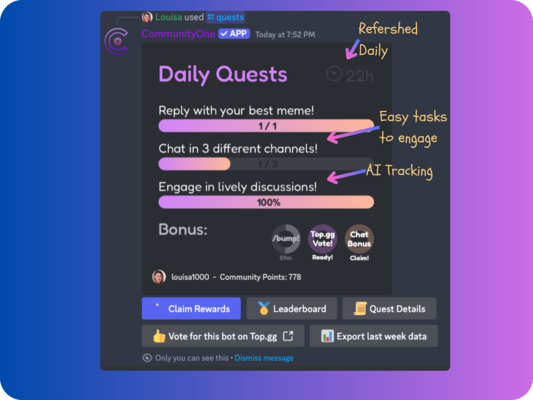
- quests (including Discord-specific engagement quests like chatting with people)
- leaderboards to motivate participation through status
- special roles tied to contributions or performance
- shout-outs and hall-of-fame-style recognition
The underlying motivation is recognition: users want to be number one on leaderboards and earn special roles.
The workshop also discusses analyzing internal engagement patterns from quest systems to understand how long users stay active.
Conclusion: Your checklist for a “forever” Discord community
Building a forever Discord community comes down to a few repeatable systems:
- Prevent common failure causes: keep onboarding new members and maintain fresh content.
- Create give-and-take: ensure a clear purpose and rewarding interactions.
- Start with a core group (around five plus or minus two) and build around it.
- Define contribution processes so members know exactly what they can do.
- Run feedback loops: daily check-ins and fast action on feedback.
- Make it personal: create emotional support and visible roles for contributors.
- Use repeatable engagement tools: quests, leaderboards, roles, and recognition.
If you implement these pieces as systems—not one-time events—you give your Discord community the best chance to stay active long after the initial launch excitement fades.