Discord can be more than a chat channel—it’s a live platform for many-to-many relationships. That makes it ideal for communities that want real interaction, learning, and ongoing engagement. The challenge is doing it in a way you can manage yourself and sustain over time.
This masterclass-style breakdown covers what to set up before launch, how to prevent spam and scams, how onboarding should work in the first minutes, what actually drives retention, and which Discord KPIs to track while you scale.
DIY Discord community management: what to cover before you launch
The speaker’s core message is simple: you can build and manage a Discord community yourself, and you should. Your Discord server should function like a core company asset—something that compounds engagement—rather than something you constantly outsource.
Before launch, focus on four practical areas:
1) Server structure and clarity
- Keep the server and channels understandable.
- Make sure new members quickly understand what the community is about.
2) UI clarity (especially on mobile)
- People don’t immediately know what your Discord is about, so the top messaging and the “what this is about” content needs to land fast.
- A key benchmark mentioned is that you effectively have around 3–4 seconds before users decide whether to stay.
3) Bots and permissions to prevent spam/scams
- The masterclass emphasizes using the bot ecosystem and tools to protect the server.
- Use recommended bots for security and spam/scam prevention as part of your baseline setup.
4) Basic security design choices
- Use least-privilege permission design.
- Restrict risky settings and avoid overbroad bot permissions.
Discord scale strategy: manage hype and build sustainable engagement
Scaling on Discord isn’t just about getting more members; it’s about converting attention into ongoing many-to-many engagement.
The speaker frames Discord as unique because it’s a live platform where community members can:
- answer each other,
- learn together,
- and sustain engagement beyond the founders.
They also highlight that Discord’s capabilities support multiple experience types:
- bot-based and custom experiences via Discord’s bot ecosystem and SDK,
- live experiences that can be token-gated or verified (with the trade-off of added friction during verification).
A key practical contrast is also made:
- Telegram is stronger for one-way communication and read-only groups.
- Discord is better when you want members to actively participate, ask questions, and interact.
Onboarding, mobile UX, and security to prevent spam
Onboarding is where many Discord launches succeed or fail. The masterclass points out that, especially after the pandemic era shift toward Discord by schools and clubs, many new users are digitally native and expect fast, simple entry.
Server onboarding that works (mobile-first reality)
- Keep the server structure and channels simple.
- Ensure the “what this is about” message is visible immediately.
- Remember the 3–4 second impression window.
Security and permission design (least privilege)
The speaker stresses that security and friction must be balanced, especially when you’re growing.
Use these principles:
- Least privilege: don’t give broad permissions.
- Restrict admin control and risky settings.
- Close risky actions (the summary notes webhook risk as an example).
- Be careful with verification configuration and bot permissions.
Auto-moderation for spam
To reduce spam, the masterclass recommends deploying auto-moderation tools and specific server rules.
One named approach is Vic (as an auto-moderation tool recommendation). Additional measures described include:
- disabling * tagging,
- controlling link posting,
- using trade-offs like *“no images / no memes” to limit common spam tactics.
If you’re doing token/NFT or airdrop-style marketing, the masterclass notes that you should beef up your security around verification before you scale.
Hiring Discord moderators: training, expectations, and engagement KPIs
Moderators become important when:
- the community is high-profile, or
- frequent new members require a reliable first line of defense.
The masterclass frames moderation as both:
- a security layer (protecting against attacks when the community team isn’t active), and
- an engagement layer (helping members participate).
Moderator training matters (especially for sensitive actions)
If you hire early, train moderators on sensitive actions such as:
- bans,
- kicks,
- and removing users.
The point is that moderators shouldn’t “manage” without guidance.
Set expectations around engagement
In the early stage, moderators and community managers primarily focus on engaging members, not only answering questions.
KPI examples for moderation
The masterclass provides KPI direction that emphasizes engagement behaviors, such as:
- words per message, and
- the percentage of users that moderators have interacted with.
Onboarding in the first 5 minutes: greet fast and avoid “chatters”
One of the clearest tactics in the masterclass is the “first five minutes” rule.
The best onboarding experience mentioned is when new members are welcomed within the first five minutes—by moderators or other community members.
The “chatters” problem
A common mistake is relying on people who only talk to each other. The speaker warns that if “chatters” keep conversing among themselves, new users may assume they won’t be included.
Instead, the masterclass suggests training chatters to behave more like community helpers:
- pull new users in,
- start conversations,
- and guide onboarding tasks.
Make participation easy
Onboarding should provide instant, low-effort ways to participate, such as:
- intro prompts,
- events,
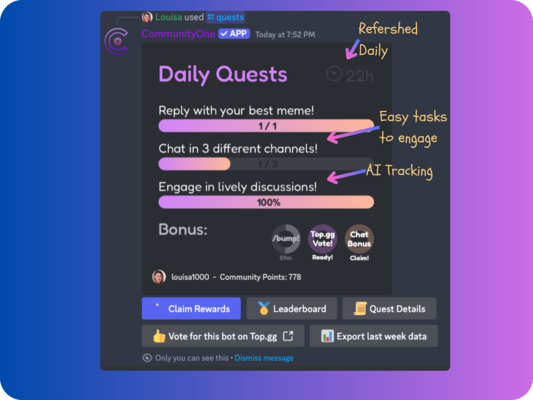
- and async participation like quests.
Why members stay: friends, announcements, events, and voice
Retention on Discord isn’t driven primarily by rewards. The masterclass emphasizes that people return to build relationships—friends and community—regardless of whether someone is an air-drop seeker, a normal user, or a developer.
The early goal: help people make friends
When the server is small, the early goal is to help members make friends with:
- you, and/or
- each other.
If you want sustainable engagement, design for friendships.
Announcement channels as a first entry point
Announcement channels are described as a common first stop for many users (about half check announcements first). They should feel more intimate and authentic than one-way social feeds.
Events are the “bloodline”
Events are positioned as a central retention driver. The masterclass breaks events into three types:
- async events (participation-based, e.g., typing challenges),
- semi-sync events (scheduled and casual, often mixing presence and voice/chat),
- live stream events (higher effort and typically lower participation).
Voice chat is underutilized—but valuable
Voice chat is described as a major engagement lever because hearing each other’s voices improves friendship recall.
It can also work even with smaller numbers because moderators can participate without requiring large amounts of additional content.
Discord early stages: one-on-one building, super fans, then scaling
Before aggressive growth, the masterclass recommends expectations and pacing.
Avoid aggressive marketing early
In the early stage, avoid trying to scale immediately. Instead, focus on building.
Start with one-on-one interactions
The suggested approach is to:
- talk with individuals,
- learn about what’s going on for them,
- and build genuine friendship.
The masterclass describes a typical evolution:
- quiet conversations with you,
- then a super fan helping in your absence,
- then multiple super fans bringing friends and forming peer networks.
Plan realistic timelines
A timeline mentioned is:
- 4–6 months to build an initial community from scratch.
- minimal marketing during the first 1–2 months.
Organic channels first
When it’s time to scale, the masterclass recommends:
- organic channels first (e.g., Reddit/YouTube/Twitch)
- then Discord listing sites.
It also notes an “automation risk” if you aggressively campaign—because it changes behavior and can introduce bad traffic quality.
Discord growth checklist: online rate and join/leave churn
Once you scale beyond the early phase, you need to measure whether new members are actually engaging.
Online rate benchmark
Track the percentage of total users who are online.
- Aim for around 10%.
- Depending on the community, even ~5% may be acceptable.
- If it drops below about 3%, adjust marketing strategy because the issue is often tied to low-quality invites or incentives.
Monitor join vs leave
The masterclass emphasizes churn as a signal.
- If a lot of people leave, it can indicate confusion about what the server is about.
Also watch out for recruitment tactics:
- invite competitions rewarding top inviters can drive unrealistic recruiting and botting behavior that doesn’t sustain.
Captcha verification join rate trade-offs
Verification can be a major friction point. The masterclass provides specific guidance around verification success rates.
It states that captcha-style verification can reduce join rates significantly.
Key points mentioned:
- verification success rates can be as low as ~25% in some cases,
- an ideal target is ~75–80%,
- mobile issues can make captcha harder (the summary notes a black-out experience on mobile during verification),
- and “capture” verification is described as the hardest.
If verification is frustrating, users may leave rather than completing the join flow.
Discord KPIs: chat rate, message quality, and conversion proxies
Chat activity is a better signal of retention and quality than raw join numbers.
Chat rate and engagement benchmarks
The masterclass provides a practical engagement target:
- aim for roughly 15–25% of total daily users actually chatting,
- and monitor engagement beyond “verified” entry.
The speaker notes that the verified-to-chat relationship can vary; they describe a goal around 50% of verified users chatting, which corresponds to ~25–15% of total daily users depending on how many are verified.
Message quality: one-message rate
To measure whether participation is meaningful, track message depth.
- The masterclass recommends keeping the one-message rate under 35%.
- High one-message rates can indicate forced participation or that members aren’t getting enough moderator response.
Act on what you learn
When KPIs indicate problems, the masterclass suggests fixes such as:
- moderator/community-manager training,
- improving prompts so members ask better questions and tag appropriately.
It also mentions using Discord-related analytics to identify where users get stuck.
Conversion proxy for “potential buyers”
If your Discord has a commercial goal, the masterclass suggests tracking conversion proxies rather than assuming all verified members have community fit.
One model described:
- in an 8-day window, users who are active on at least three days and send around 15 messages or more are more likely to buy.
Conclusion
A sustainable Discord community comes from three things working together: a clear setup, friction-aware security and onboarding, and retention systems built around relationships.
Use the masterclass approach as a checklist: launch with simple structure and fast mobile UX, add anti-spam and least-privilege permissions, welcome members within the first five minutes, prioritize events and voice for friendship-building, and track Discord KPIs like online rate, join/leave churn, chat rate, and message quality. Then scale using organic channels—slow enough to protect quality, fast enough to grow engagement.