Most Discord growth tactics look great at first—until engagement decays. In practice, many servers experience “hyper growth” from marketing, but then users either leave or stop chatting. The result is growth that’s inefficient and hard to sustain.
This article translates the video’s core lesson into a repeatable framework: shift from acquisition-only thinking to sustainable engagement built on the right people, the right daily habits, and the right quest/reward mechanics.
Why Discord hyper-growth can become waste
The video frames the central problem like this: when you push fast acquisition, you often get a short burst of new members—but not the daily activity that keeps a community healthy.
After marketing-driven hyper growth, users may:
- Leave shortly after joining
- Stay but stop participating
- Fail to build real relationships inside the server
That’s why “growth” and “engagement” can diverge. A community can increase in member count while meaningfully participation stalls.
The practical takeaway is simple: triple growth doesn’t matter if it can’t be sustained through repeatable daily engagement.
Two requirements for retention: super fans + a daily reason to return
The video highlights two requirements for long-term engagement.
1) Super fans
Super fans are not just highly active users. They are members who repeatedly:
- Try the product
- Share it
- Provide honest feedback
- Help answer questions when the founders/team aren’t around
- Build a friend-like connection with other community members
In other words, super fans reduce pressure on the creators while improving onboarding quality. Newcomers aren’t relying solely on founders to respond instantly.
2) A daily reason to come back
Even with a welcoming community, members need a reason to return every day.
The video describes daily return as coming from things like:
- Events
- Social connection
- Recurring community moments
A sustainable server develops daily patterns—what matters most is not random spikes, but consistent daily chatters.
Gamification that works: tasks, timing, and rewards (avoid grinding)
To increase daily engagement, the video advises against expecting users to “naturally” chat after onboarding. Instead, use engagement gamification with clear participation tasks and the right rewards.
Measure engagement with meaningful activity
The video mentions engagement measured by messages per active user. The speaker reports an average around 20 messages per session (about 40 minutes), which they summarize as roughly one message every two minutes across communities.
You don’t need to copy the exact number, but you should track a similar concept: participation per active member.
Use simple participation tasks
Tasks should be:
- Easy to complete
- Low friction
- Not heavily dependent on prior community knowledge
The video emphasizes tasks that produce real interaction. It contrasts:
- “Be engaged in a lively discussion” (desired)
with
- “Send the most amount of messages” (undesired)
A useful design goal mentioned is aiming for around 10 minutes of participation.
Don’t reward volume or grinding
A key warning is to avoid rewarding grinding. Grinding can create high activity numbers without strong conversation quality.
The video explicitly cautions against:
- Giving out cash right away
- Giving rewards for grinding
Your gamification should reinforce the behaviors you actually want to see in your community.
Product-relevant rewards and special permissions to boost daily activity
Rewards matter because they shape what members optimize for.
Keep rewards aligned with the product and platform
The video recommends product-relevant rewards tied to your community’s ecosystem. It mentions Nitro as the example reward.
The idea is:
- Rewards should feel related to participation
- They should be valuable specifically to active members
Use roles and permissions to increase meaningful participation
Beyond prizes, the video highlights special roles and special permissions.
Even small permission upgrades can influence behavior. The video example mentions enabling users to send a link in General chat, framed as a permission that can strongly increase responses.
Practical implication: pair rewards/quests with permissions that enable members to contribute—not just to collect points.
Super fans: what they do, how to define them, and how organic growth happens
The video provides a clear “super fan” definition grounded in behavior.
It describes super fans as members who repeatedly:
- Try the product
- Discuss the product
- Return with honest feedback
They also become essential for day-to-day support:
- Answer questions when founders aren’t around
- Help newcomers feel welcome
A practical lens: sustained engagement signals
The video uses a scoring/quest system to define super fans. It states that a user scoring close to 1,400 points over the first three weeks likely indicates sustained engagement (described as around half an hour per day).
It uses this as a basis for defining a super fan.
Super fan growth should be organic—not an invite program
One of the video’s most important cautions: do not ask super fans to invite friends.
The reason given is that it can:
- Reduce quality (invite targets are unclear)
- Feel like a grind to super fans
Instead, the video claims healthier organic growth looks like:
- Super fans connecting through communities/projects they already participate in
- Founders and core members encouraging early feature adoption and consistent interaction
The video summarizes the community composition with an “about 80% social and 20% product” framing.
Practical Discord tactics: quests (Hype Engine), emotes, bots, and leveling cautions
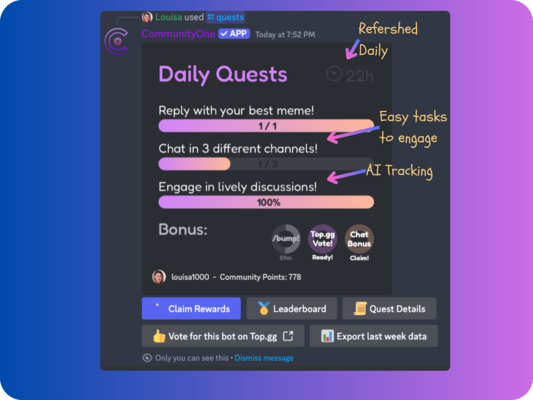
Use quests to create a daily habit
The video recommends a quest feature called “Hype Engine.” It’s presented as a website experience that’s implemented across communities.
The key operational advice is:
- You must enable the feature
- But internal adoption matters most
The video recommends having at least one advocate use the quests for three days so others can see it and join in.
It also reports outcomes like tripling average messages per user and increasing daily chat users, framed as observed results.
Enable advocates before you scale
The “advocate for three days” approach is consistent with the broader super fan idea: show what “good participation” looks like.
Use emotes and bots carefully
The video also mentions tactics such as:
- Joining servers with specific emotes and using them to drive engagement
- Using bots/features (including the idea of enabling the platform’s quest mechanics)
Be cautious with leveling systems
The video discusses leveling bots that grant roles based on message counts and user levels. But it also warns that poorly designed leveling can lead to:
- Excessive grinding
- Abuse
- Leaderboard farming
If you use leveling, the lesson is to design it so it supports healthy discussion rather than encouraging raw message volume.
Turning explosive growth into steady engagement
The video includes results from a marketing campaign, describing community size increasing from about 800 to about 3,000 over roughly one week—described as tripling growth during the marketing period.
But the more durable insight is what changed alongside growth:
- Earlier campaigns felt mechanical and were led by only a few people
- The new approach felt more organic and sustainable
The video also advises pacing or delaying explosive growth until the community is ready for onboarding that supports daily engagement. When members can rely on super fans, quests, and real participation incentives, the community becomes more self-sustaining.
Conclusion: build sustainability, not just acquisition
To triple Discord growth and keep it from decaying, the video’s framework boils down to:
- Install the human system: super fans who welcome, teach, and answer questions
- Create the daily habit: a daily reason to return (events, social connection, recurring moments)
- Use engagement gamification that rewards real interaction—not grinding
- Choose product-relevant rewards and pair them with roles/permissions that enable contribution
- Run quests with internal adoption first (one advocate for three days), and be careful with leveling mechanics
If your server can consistently generate daily participation, growth becomes efficient—and sustainable.