Why Discord support works better than basic ticket tools
Many teams treat “Discord support” as a matter of installing a ticket system. The video argues that this is often the “lowest hanging fruit,” because it pushes every question into private, one-to-one handling—something you can’t sustain at scale.
Instead, define two core goals:
- Answer questions as quickly as possible when people ask.
- Do it at scale so support doesn’t collapse as your community grows.
Discord can support both goals when you design your community channels around public, searchable help rather than private escalation.
Use public Q&A to keep support in the community
When a member joins and asks a question, the first priority is getting it answered. But the bigger opportunity is what happens next: if the answer stays in public, others can find it later and the community remains active.
The video’s recommended approach is simple:
- Encourage people to ask in public channels.
- Let community members (and your team) answer in the open.
- Reserve private tickets for cases that truly need privacy.
This also improves the experience for new users. The video notes that new members effectively do an “instant search” after joining, so moving knowledge into private areas can hide answers and increase repeat questions.
Add AI to handle first-pass answers in public
AI can help you speed up public support, especially when your team can’t answer everything manually.
The video describes a pattern:
- Use AI to read your documentation.
- Have it answer questions directly in a public channel.
However, there’s an important nuance: many users start with AI out of speed or because they feel embarrassed to ask. The best practice is to bridge from AI to human support.
Practically, that means:
- When AI needs help or the situation is more complex, jump into the conversation and provide human guidance.
- Keep the conversation public so future members can benefit from the final resolution.
When to use Discord ticket systems (and when not to)
Tickets can still be useful, but the video frames them as a tool for truly private information, not as the default support route.
For example, some sensitive items may require private handling, while not all “sensitive-sounding” items do. The video notes that even something like a public wallet address may not require ticketing.
What to look for in a ticket system
If you do decide to use tickets, the video emphasizes reliability and usability. Key requirements include:
- Easy setup
- A login/transcript system (so issues are reviewable)
- Scaling controls, since some ticket bots scale better than others
The video also mentions testing multiple ticket tools and recommends Ticket King as fast to set up and reliable, with scaling considerations.
Use ticket categories and limits
To avoid misrouted requests and overload:
- Set up ticket categories
- Use limits (the video references up-to-thread-per-category scaling behavior)
- Prevent tickets being opened in the wrong place by closing/redirecting them appropriately
Tickets create private threads, which is exactly why you should reserve them for cases where public discussion isn’t appropriate.
Support operations: reminders, auto-closure, and logging
Once you have tickets (even if only for private cases), you need operational safeguards.
The video calls out three support automation elements:
- Auto reminders: if a moderator forgets to follow up, the system should nudge the process forward.
- Automatic closure: when a moderator indicates the ticket should close, the system can close it after a configured time.
- Detailed logging: capture what happened so you can track support patterns and improve over time.
If your ticket bot provides dashboards and logs, that can also help you review and act on recurring issues rather than repeatedly re-litigating the same problems.
Use Discord Forums and tags to get higher-quality feedback
For feedback (and many support-adjacent discussions), the video recommends shifting from generic channels to Discord Forums.
Why forums?
- Posting typically requires more effort than sending a quick message.
- That reduces spam and increases genuine intent.
- Discussions tend to contain more useful context.
How to structure forums with tags
To keep forum discussions actionable, use tags for categorization. The video describes tags such as:
- Product or feature area
- Issue type (for example: bugs)
- A “resolve” tag to mark outcomes
It also emphasizes weekly review of forum threads so you can identify outstanding bugs and suggestions that are worth implementing.
Turn messy Discord input into an actionable feedback loop
Discord is inherently “messy”: valuable conversations mix with lower-signal messages. The video’s approach is to treat feedback as something you must organize, synthesize, and close the loop on.
Apply the 80/20 focus
A practical rule in the video is:
- 20% of users provide 80% of feedback
Instead of trying to collect from everyone equally, focus on:
- Cultivating and converting people who are likely to submit high-value feedback
- Rewarding feedback behavior so contributors keep engaging
Encourage structured follow-ups
The video describes a system where feedback isn’t just “submitted and forgotten.” Users can be asked to respond in a structured way (for example, yes/no/maybe style follow-ups), and then receive continued follow-up from your team.
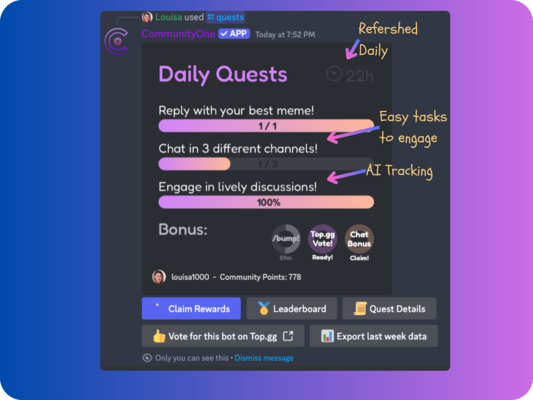
Reward contributors with points and quests
To keep momentum:
- Reward users generously, especially the first time they provide meaningful feedback
- Use points/quests or similar engagement systems so feedback has visible value
The video also highlights that investing in the right feedback behaviors can lead to users returning to provide more.
Invest sprint time in the improvements discussed on Discord
Collecting feedback isn’t enough—you need to commit development time.
The video recommends dedicating a meaningful share of sprint time (50–60%) to features that are requested and discussed in Discord.
When you prioritize, use an “accumulation over time” approach:
- If multiple independent community members request the same improvement, it’s a strong sign to prioritize—even if the work is difficult.
Sync Discord feedback to Slack and track it over time
Your team may not live in Discord. The video suggests bridging the gap so product and stakeholders can see patterns.
One workflow mentioned:
- Use a bot dashboard to take screenshots of the problems people are having.
- Post those screenshots to Slack.
The bigger goal is long-term tracking. The video notes that having a tracking system across years helps you validate which Discord-driven improvements are actually valuable—especially if community management changes over time.
Synthesize feedback to persuade internal teams
Finally, feedback often needs interpretation before it convinces decision-makers.
The video warns against relying on raw counts alone. Discord content is mixed, and numbers don’t automatically explain why users care.
To persuade effectively:
- Have the person closest to Discord (and the consumer market) review and synthesize feedback.
- Present high-level summaries plus specific stories.
- Focus on user motivations and outcomes rather than “how many people complained.”
A useful persuasion framing is based on purpose: what users wanted, and how they plan to use the feature or solution.
Conclusion: build scalable Discord support with public help and a real feedback system
Scalable Discord support isn’t about handling everything privately. It’s about designing a community-first system:
- Get questions answered in public so knowledge compounds.
- Use AI for first-pass public help, then transition to humans when needed.
- Use tickets only for truly private cases, with reminders, closure, and logging.
- Capture higher-quality feedback with Forums and tags, reviewed weekly.
- Reward contributors, commit sprint time, and track/sync feedback to support long-term product decisions.
If you want scalable support on Discord, the key is turning conversations into reusable knowledge and measurable improvements—not repeating the same work in private.