If you run a Discord community, guessing what new members experience is expensive. This guide turns Discord analytics into practical, action-driven KPIs you can use to improve onboarding, engagement, moderation, and retention.
We’ll start with Discord Server Insights (and its limits), then move to the exact signals to track—especially during the first minutes after someone joins—and finally cover moderation and chat quality metrics.
Start with Discord Server Insights (and know its limitations)
Discord has a server panel called “Server Insights.” It can help you understand server activity patterns and member flow.
The video also highlights important limitations:
- Server Insights may not be available to everyone.
- Some data may be missing or delayed, including a one-week gap.
- The available detail may not be enough for everything you want to measure.
Even with those limitations, Server Insights can still provide useful direction—especially when you use it to answer concrete operational questions.
Use action-driven analytics: track behaviors tied to outcomes
The core framing in the video is “action-driven analytics.” The goal is to prevent the common failure mode where teams look at dashboards and decide the data is unusable.
Instead, track what you can directly influence. The video focuses on three areas:
1) Onboarding in the first minutes after joining
2) Engagement and retention signals over time
3) Moderation performance and chat quality
Onboarding analytics: measure what happens in the first five minutes
A major theme is protecting the early funnel. The first five minutes after someone clicks your invite link are where you’ll see the biggest drop-offs.
Track verification rate and onboarding friction
Measure how many people become verified after joining:
- Use “verification rate” (new joins vs. verified users).
- The video mentions benchmark targets such as roughly ~50% and higher (up to ~75%+ in top servers).
It also emphasizes verification friction and timing:
- Aim to keep verification under 30 seconds.
- Avoid high-friction and risky verification flows.
The video gives specific “don’ts” for verification:
- Don’t require members to click out to an external site as part of verification (it adds risk, including scam/token-theft concerns).
- Watch for mobile CAPTCHA issues (the difficulty of reading characters/case sensitivity).
- Avoid approaches that add fear or force unnecessary wallet connections.
Finally, decide whether you need a verification bot based on server type:
- The video notes that commercial servers (e.g., incentivized or payment-driven contexts) may need different approaches than smaller community servers.
Measure onboarding success beyond “joined”
Verification is only the start. The video frames the next step as “technical onboarding” and early participation—what happens right after joining.
A practical onboarding goal is to design a short path that prompts members to chat quickly. The video suggests a “five minutes” onboarding concept and reports an observed target range:
- Aim for about 20% to 50% of users to chat within the onboarding window.
If you see low early chatting, the video lists likely causes:
- Overly complicated onboarding surveys
- Too many channels causing decision fatigue
- Social dynamics that intimidate new users, or a server culture that devolves into unclear or unproductive talk
Moderation KPIs: measure what moderators do and how it affects chat
The video argues that moderators shape engagement quality the most. So moderation needs measurable KPIs—not just subjective impressions.
Track moderators’ interaction and responsiveness
A recommended approach is to track moderator performance in an action-oriented way:
- Look at how many people moderators talk to and engage with.
- This is especially important in smaller servers.
The video connects moderation to chat quality directly:
- Quality is improved by moderators being human, consistent, and prompt.
- “Talking like a human” is called out as a concrete action recommendation.
Use message retention as a quality signal
For chat health, the video emphasizes a metric it calls “message retention.” The idea is to measure whether members keep participating after their first message.
One benchmark mentioned:
- If about ~33% of members send exactly one message, that’s presented as a benchmark.
- If many users send only one message and bounce, it can signal unmet needs—such as questions not getting answered—or a too-technical experience that discourages participation.
Use five-minute chat retention to measure ongoing activity
The video introduces “five-minute chat retention” as a sister KPI:
- Measure what percentage of users who send a message keep sending messages within the next five minutes.
This KPI helps you evaluate whether the server (and moderators) is responsive during active moments. The video suggests moderators can improve this by being alerted quickly when users ask questions—particularly in quieter servers.
Add depth signals: conversation “communicator” metric
Besides retention, the video recommends estimating conversation depth.
The metric described is a “communicator” measure:
- Use messages per chatter (how many messages each participating member sends).
The video frames this as a way to estimate whether the server’s conversations are shallow or more in-depth, and notes a rough mapping between message count and time spent chatting.
Improve quality with open-ended, easy-to-join conversations
Once you have the KPIs, you still need the right conversation structure.
The video recommends:
- Make conversations easy to join.
- Keep them relatively personal but also open-ended.
It also points to quality as a lived indicator:
- When moderators respond to people early and often, it’s a signal the community is strong.
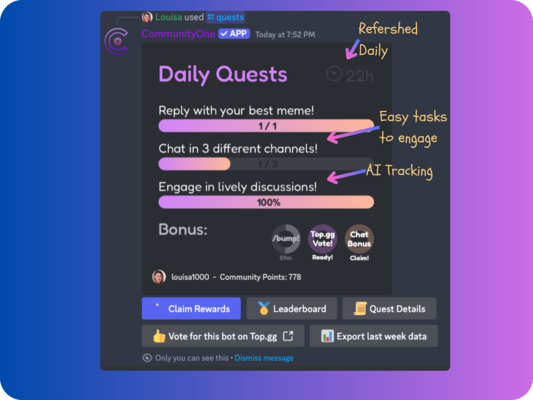
Use quests and guided participation to extend time in the community
To improve retention and engagement behavior, the video suggests gamification and guided participation.
The approach is to encourage members to initiate conversations and extend their time in the community using lightweight prompts or quests.
An example quest format mentioned:
- “chat with three people”
The intent is to prolong time in the community and support better chat retention. The video also connects this to improved quality over time when members learn what to do and moderators guide them.
Better onboarding with analytics + moderation routing
The video recommends using analytics/logging approaches to find who joins so moderators can respond quickly.
A practical workflow described:
- Have a system (the video mentions a bot concept) to log who joined.
- Moderators then welcome and tag new members.
- Route them to helpful or fun actions and activities.
This is framed as a way to turn raw join data into better early participation.
Use growth metrics carefully: daily incoming members and promotion channels
The video also touches community growth, using analytics to inform operations.
For growth tracking:
- Track daily incoming members.
For promotion, the video mentions using:
- Community promotion channels
- The Discord bump board (via /bump)
- Reddit
- Collaborating with other communities
It also warns against certain growth tactics:
- Don’t ask members to invite friends as a strategy, because it can introduce a large number of bots into the community.
Conclusion
Discord analytics become valuable when they’re tied to actions you can change. Use Server Insights to understand member flow, then focus on measurable, behavior-based KPIs:
- Onboarding verification rate and early drop-offs in the first five minutes
- Chat signals like message retention and five-minute chat retention
- Conversation depth through messages per chatter
- Moderation performance through how quickly and how broadly moderators engage
When you pair these metrics with fast verification, simple onboarding, responsive moderation, and guided participation (like quests), you can systematically improve onboarding, chat quality, engagement, and retention.