Understanding Ashari, Athari, and Maturidi Aqidah
- مشاركة هذه المناقشة
- نسخ الرابط
- مشاركة على X (Twitter)
ملخص
The .gg / 𝐗𝐲𝐧𝐭𝐡𝐰𝐚𝐯𝐞 𝐀𝐫𝐜𝐚𝐝𝐢𝐚 /🗿🥂 server provides an educational breakdown of the fundamental differences between the Ashari, Athari, and Maturidi schools of Islamic creed. This discussion highlights the importance of Aqidah, distinguishing between rationalist and literalist approaches to divine attributes. Members are encouraged to explore foundational texts like the works of Imam Ahmed ibn Hanbal to deepen their understanding of orthodox belief.

as far as i know most of the people or scholars in my country are ashari's how do i switch to athari gng  there is a minority of people following athari too i guess but the majority are asharis

oh

im gonna forward a vn
lemme find

bro
transcript
right click on vn
and send it to an AI
my elec died
i aint on pc
u might me
atharis:
literalists (follow reports {athar}) with the understanding of the salaf
asharis:
pseudo rationalists, they take the reports and use rationalistic techniques to do ta'wil on some attributes so it better fit their rational categories. forexample, when Allah says in quran 20:5 that he is established on the throne, asharis take it as a sign of power, not Him being on the throne
maturidis:
same like asharis, but more rationalist.
additionally, theres mutazilis. which wre considered outside of orthodoxy of islam. they deny all attributes and affirm absolute divine simplicity
an important point on the diff between schools of fiqh and aqidah is that u can follow any school of fiwh
fiqh
but u canNOT follow the wrong school of aqidah
aqidah is very important
it cannot be compromised
let me share more beneficial things inni
theres a poem
of athari creed
this is a book by Imam Ahmed ibn Hanbal رضي الله عنه
he DESTROYS those who deny the attributes of Allah
al-Shaykh Muḥammad ibn Ṣāliḥ al-ʿUthaymīn said:
First, we must know: what is ʿAqīdah (creed)? ʿAqīdah is that which the heart firmly holds of faith and certainty.
It is what the heart is firmly bound to of īmān and conviction, regarding what one must believe in: faith in Allāh, His angels, His Books, His Messengers, the Last Day, and the Divine Decree (al-Qadar). This is the ʿAqīdah that Shaykh al-Islām Ibn Taymīyyah intended, namely, the creed of the saved and victorious sect.
The Prophet ﷺ clarified it when he was asked about īmān. He said: "That you believe in Allāh, His angels, His Books, His Messengers, the Last Day, and the Divine Decree, its good and its evil."
Think of Islam as a massive, beautiful building: if the actions you do (like praying or fasting) are the walls and the roof, your ʿAqīdah is the concrete foundation buried deep underground. If the foundation is solid, the building stands forever; if it is weak, the building cracks. When your ʿAqīdah is correct, you understand that Allah is in total control and that He loves you. This removes anxiety about the future and sadness about the past.
We derive our ʿAqīdah strictly from divine revelation (waḥy). Because the matters of the unseen (ghayb) cannot be perceived by human intellect, logic, or emotion, we rely exclusively on three authoritative sources.
The Qurʾān is the primary source of ʿAqīdah. It is the literal, uncreated speech of your Lord, speaking about himself. Every fundamental belief regarding Allah's names, His attributes, the angels, the day of judgment, and past prophets is explicitly laid out in the text of the Qurʾān with absolute certainty. We do not interpret these verses through human philosophy or metaphorical distortion.
Then, we refer to the Sunnah which refers to the statements, actions, and approvals of the Prophet Muhammad ﷺ. In matters of creed, we rely on authentic (ṣaḥīḥ) aḥādīth, as recorded by the scholars of ḥadith (such as Al-Bukhārī and Muslim). The Prophet ﷺ was directly inspired by Allah, and his explanations of the Qurʾān and the unseen world are binding.
We then derive our ʿAqīdah from the Salaf al-Ṣāliḥ (the Pious Predecessors) are the first three generations of Muslims: the Companions (Ṣaḥābah), the Successors (Tābiʿūn), and those who followed them. We look to their unanimous agreement (Ijmāʿ) because they learned the faith directly from the Prophet ﷺ, spoke pure Arabic, and were free from the philosophical deviations that arose later in Islamic history.
a note regarding attributes
And he (ie: Muḥammad b. ʿAlī al-Qaṣṣāb) said: Any attribute that Allah has ascribed to Himself or that His Messenger has ascribed to Him, then it is not a Ṣifah majāz (ie: metaphorical Attribute). If it was metaphorical, then it would have been necessary to explain it in a manner different from the apparent meaning (ie: known understanding).
So it would have been said: “What is meant by al-Baṣar (ie: vision) is such and such, what is meant by al-Samaʿ (ie: hearing) is such and such, and so on.” It would have been explained in a way different from what one would understand from the apparent meaning.
As the approach of the Salaf is to affirm the attributes without taʿwīl (interpreting), different from the known meaning (what is apparent), this proves that they are not to be understood metaphorically; rather they are clear truth (ie: plain facts).
All praise and thanks is due to Allah al-ʿAlī (ie: Tʿhe Most High), al-ʿAdhīm (ie: The Supreme), al-Samīʿ al-Baṣīr (ie: The Hearer and The Seer), al-Ḥakīm (ie: the Wise), al-Karīm (ie: The Bountiful), and source of the affluent blessings, vast benedictions and conclusive proofs. The Lord is beyond the grasp of and is incomparable to those of limited qualities. He cannot be compared to the created things. He is pure of what the muʿaṭṭilūn (ie: those who practise taʿṭīl and reject His attributes) attribute to Him.
He transcends high above the seven heavens, above His throne (ʿarsh). He knows the hidden secrets. He hears audible speech as well as whispers (in the hearts). Nothing can escape His knowledge be it set on al-ʿarḍ (ie: the earth), put in the heavens, buried in the depths of the seas or suspended in the atmosphere.
Proofs of God rising above the throne
-
- [1] al-Qur'ān 7:54, Sūrah al-Aʿrāf (open in browser)
-
- [2] al-Qur'ān 10:3, Sūrah Yūnus (open in browser)
-
- [3] al-Qur'ān 13:2, Sūrah al-Raʿd (open in browser)
-
- [4] al-Qur'ān 20:5, Sūrah Ṭāhā (open in browser)
-
- [5] al-Qur'ān 25:59, Sūrah al-Furqān (open in browser)
-
- [6] al-Qur'ān 16:50, Sūrah al-Naḥl (open in browser)
-
- [7] al-Qur'ān 67:16-17, Sūrah al-Mulk (open in browser)
-
- [8] al-Qur'ān 16:50, Sūrah al-Naḥl (open in browser)
-
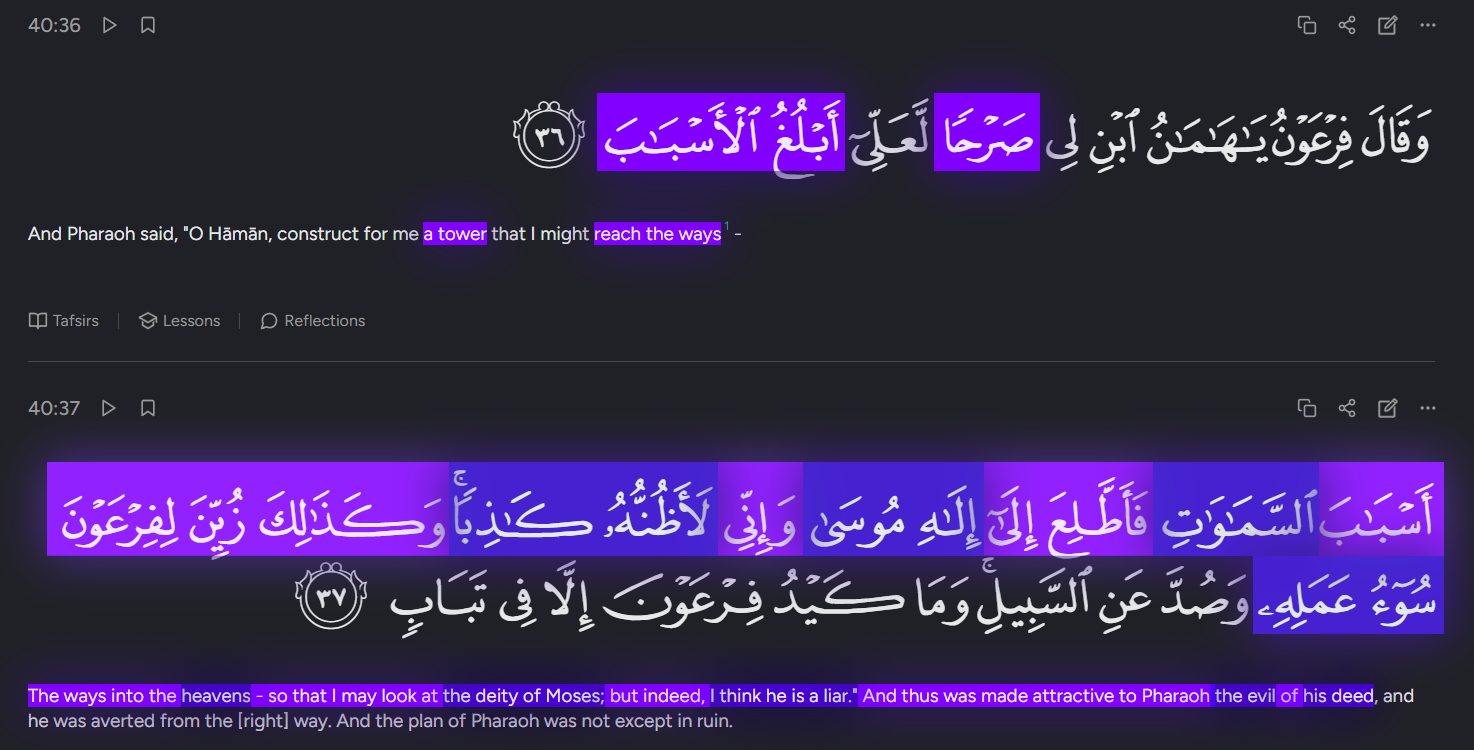
[9] al-Qur'ān 40:36-37, Sūrah al-Ghāfir (open in browser)
I say: This passage from Sūrah al-Ghāfir has greatly troubled the Jahmiyyah and their offspring. Those who object to these verses, those who attempt to explain away Pharaoh’s words, and those who claim—by way of evasion—that the creed of Ahl al-Sunnah originates from Pharaoh have all failed in their refutation of the clear ithbāt (affirmation) of Allāh's elevation embedded in these verses. Abū Manṣūr al-Māturīdī al-Jahmī made his attempt in his tafsīr (exegesis) that this may have been a false notion that circulated among the polytheists of Egypt at the time.¹
The passage affirms that Moses (peace be upon him) must have told Pharaoh and his people that their Lord, Allāh (Exalted is He), is above the heavens. The Pharaoh said, "Indeed, I think he is a liar," referring to the earlier statement, "so that I may look at the deity of Moses [above the heavens]" (i.e., I think he is lying that Allāh exists and is above the heavens).
Furthermore, the affirmation of Allāh being above His Throne by His Essence is one of the gravest "crimes" you can commit, rendering you a dirty, pagan mushabbih (one who likens Allāh to the creation) and a mujassim (anthropomorphist) in the eyes of the Jahmiyyah, the Muʿtazilah, the Ashāʿirah, and their counterparts. In fact, it is known that the Ashāʿirah would order the severing of the finger for the individual who even dares to point to the heavens (above).
If such a belief was as heinous as they claim it to be, then why did Allāh not correct the statement of the Pharaoh right after? Rather, Allāh reaffirmed the statement of Pharaoh by labelling his accusation, "but indeed, I think he is a liar", as a statement of evil. The Lord (Exalted is He) proceeded by saying, "And thus was made attractive to Pharaoh the evil of his deed", by which the Pharaoh was "averted from the [right] way."
Glory be to the Lord (Exalted is He), how horrible is the fate of the one who affirms the accusation of the Pharoah by believing there is no deity above the heavens—a statement and belief of which Allāh had testified he was misguided due to it.
Explicit Hadith of Prophet Muhammad ﷺ
Muʾāwīyah Ibn al-Ḥakam after slapping his slave girl said:
“I came to the Messenger of Allāh ﷺ and felt (this act of mine) as something grievous I said: ‘Messenger of Allāh, should I not grant her freedom?’ He (the Prophet ﷺ) said: ‘Bring her to me.’ So I brought her to him. He said to her: ‘Where is Allāh?’ She said: ‘Above (fī al-samāʾ).’ He said: ‘Who am I?’ She said: You are the Messenger of Allāh. He said: “Grant her freedom, she is a believing woman.””
-
- Ṣaḥīḥ Muslim 527
-
- This report is firmly established through multiple routes. It is recorded by Muslim in his Ṣaḥīḥ, and also by Abū Dāwūd, al-Nasāʾī, Ibn Abī ʿĀṣim in al-Sunnah, Mālik in al-Muwaṭṭaʾ, Aḥmad in the Musnad, Ibn Khuzaymah in Kitāb al-Tawḥīd, and al-Bayhaqī in al-Asmāʾ wa al-Ṣifāt. Imām Mālik narrated it with the name “ʿUmar ibn al-Ḥakam,” whereas the correct name is “Muʿāwiyah ibn al-Ḥakam,” and this is identified as an error by the muḥaddithīn, including Ibn Ḥajar, and the same mistake was followed by Ibn Abī Zamānīn. Al-Bayhaqī made an error in claiming that Muslim narrated the ḥadīth without the story of the slave girl, even though the story is clearly present in Ṣaḥīḥ Muslim.*


i can give u 11 reports from the salaf affirming Allah's rising above the throne being literal not metaphorical
i can give u detailed refutation of asharis/maturidis as well
NONE of them my words btw
zero extrapolations
i just quoted the book of Allah, the sunnah of His messenger, and the early predecessors whom His messenger praised.
now go and look at the evidence asharis and maturidis have
i bet on my career, not a single one of them is embedded into those three things
all of them are rooted in kalam
ok ill read after few
few
years?
😭
few days...
or hours
blegh
who knows
ill read it
inshallah