Discord growth doesn’t have to depend on an agency or constant hype. The core idea is to treat community as a company asset and build a measurable system for engagement—starting before you scale invites or run marketing.
Below is a practical playbook based on the video’s guidance: onboarding and mobile UX, permission and security hardening, hiring moderators with engagement-focused KPIs, designing retention through friends/announcements/events, and tracking Discord metrics so you can diagnose what’s working.
Build Discord community management in-house before launch
The speaker’s framing is straightforward: don’t outsource the entire process just because Discord feels chaotic. Instead, plan and run community management internally.
This is especially important because Discord is different from a broadcast platform. A “great Discord” isn’t only a space where members interact with the founders—it’s where there’s a real chance that members can talk to each other. That many-to-many dynamic is what makes community growth sustainable.
Before you launch, clarify what Discord will do for your business:
- Validate legitimacy through real chatter and active participation
- Create a discussion environment where members answer each other
- Enable the kind of community networking that works best for your audience
Choose whether Discord fits your audience (Discord vs Telegram)
Not every audience needs Discord. The video compares Discord and Telegram in terms of discussion behavior and content style.
Discord is presented as a strong fit for:
- Discussion-heavy communities
- Learning and developer-style questions
- Gaming communities
- Places where members can ask and answer each other (not just read updates)
Telegram is described as better for:
- Read-only, one-way update delivery
- Highly crypto-native audiences (with regional differences mentioned)
If your goal is two-way conversation and member-to-member discussion, Discord’s structure supports that more naturally.
Scale engagement without letting hype destroy quality
Early growth requires control. Hyper growth and aggressive marketing can produce low-quality joins that don’t engage.
The speaker describes Discord scaling as something that works best when you build community foundations before pushing broader marketing. That includes giving the system time to learn what the server is “about” and letting members find each other organically.
Onboarding that works on mobile (and reduces confusion fast)
One of the most actionable points is onboarding speed and clarity.
Keep the top of the server obvious
The video emphasizes that people need roughly a few seconds to decide what your Discord is about (the speaker states about 3–4 seconds on mobile).
Practical implications:
- Make the server’s purpose clear immediately
- Keep the UI simple and easy to scan on mobile
- Avoid complex structures that make it hard for users to know where to go next
Simplify onboarding structure
The speaker warns against confusing channel setups such as multiple posting channels that don’t guide a newcomer.
When users can’t quickly understand where to introduce themselves or how to start participating, they leave—often before they ever experience value.
Security and permissions: prevent spam and link scams before scaling
A major theme is hardening your Discord so that scaling doesn’t also scale risk.
The video points out that many attacks and spam patterns come from predictable permission problems and link-based scams. Examples of risk categories mentioned include:
- Hijacked admin/announcement accounts that push “claim” style links
- Excessive permissions that let the wrong accounts do too much
- Open webhooks and risky bot permissions
Before marketing or invite boosts, tighten configuration:
- Tighten server/category/channel permissions
- Have experienced review of backend/category permissions before you scale
- Ensure bot permissions are appropriate (avoid granting unnecessary power)
Reduce spam with moderation and automated checks
The speaker recommends using moderation tooling and policies to reduce obvious abuse. Specific guidance includes:
- Use AutoModeration-style features (an example named is “Vic”)
- Block tagging
- Optionally disable links
- Consider limiting spam-style content (a “no images” policy was discussed as an example)
Watch out for DM link manipulation
The transcript summary highlights one threat pattern: getting a user to click on a link delivered via direct message. This is another reason why permissions and moderation controls need to be designed before growth.
Hiring moderators: engagement first, with training and security awareness
Moderators are described as both:
1) A security backstop (especially when you aren’t active across time zones)
2) The main driver of early engagement
Train moderators on sensitive actions
If you hire early, train moderators on actions such as banning and kicking, and on handling security-related situations.
The speaker also notes a practical risk detail: when a community is inactive in certain time zones, hackers can look for gaps.
Set expectations for early-stage moderators
A key distinction is that early moderators shouldn’t only “answer questions.” Their primary job in early stage is to engage.
Moderator engagement KPIs (make moderation measurable)
The video recommends quantitative engagement KPIs rather than relying on intuition.
Examples of KPIs mentioned:
- Words per message
- The percentage of users moderators interact with
The point is to measure whether moderators are actually driving participation and inclusion, not only monitoring.
Improve onboarding with greetings and guided first actions
Retention starts immediately.
The speaker highlights that the most impressive communities create a welcoming experience within the first five minutes. That welcoming includes:
- Moderator greetings
- Peer greetings (including sending memes) to communicate friendliness and server culture
Be careful with “chatters”
The summary warns that “chatters” can backfire if they talk only among themselves. In that case, newcomers may feel they should stay silent.
Instead, chatters should act like mini moderators:
- Involve new users
- Pull newcomers into conversation
- Help them take their first participation step
Provide instant ways to participate
During onboarding, give new members immediate “next actions,” such as:
- Introductions
- Events
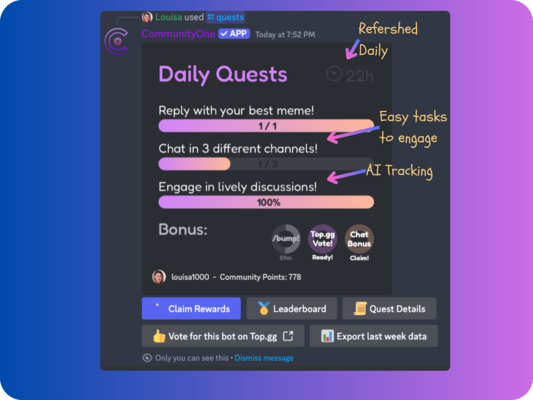
- Quests
- Async activities with clear calls to action
Retention drivers: friends, announcements, and event design
The video is clear about why members stay: they return because they have friends they built on the server.
Use announcements strategically
The speaker emphasizes that announcements often work as a first signal of whether the server is alive and being actively managed.
Announcements should feel more intimate and authentic than typical social posts. The guidance is to share:
- Real progress
- Setbacks
- Solutions
- Opportunities for community input
Design events as the “bloodline”—but don’t rely only on live
Events are described as crucial, but live-stream attendance is typically low, with the video summarizing attendance around 1–5%.
To improve retention, the speaker suggests using async or semi-sync formats rather than depending solely on live events.
Voice chat is described as underutilized but powerful for friendship-building because people remember each other longer after hearing voices. The advice focuses on early-stage activity (aiming for daily presence rather than assuming mass attendance).
Early growth phases: one-to-one, then superfan recruitment, then networks
Rather than expecting instant scale, the speaker describes a phased organic process:
1) Early engagement at a one-at-a-time pace
2) A “Super Fan” recruits others
3) A network of strong believers forms and talks among themselves
The video also recommends giving the effort time. Marketing pressure should be delayed until you understand what the community is about. The speaker suggests aiming for at least four months, and notes the average discussed as longer (with “six months average” mentioned in the summary).
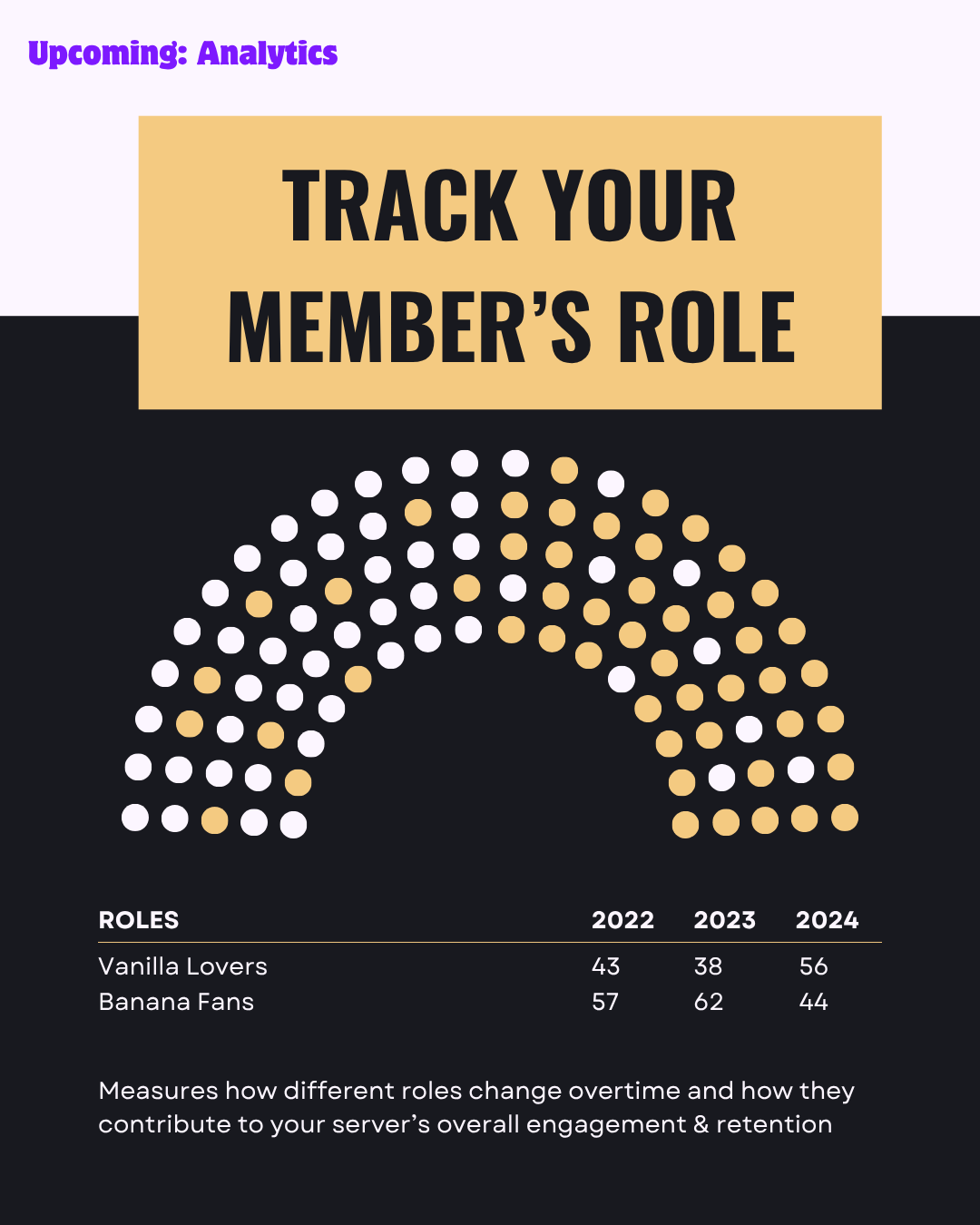
Discord growth metrics: measure online rate, joins/leaves, and verification
You need numbers to tell whether the server is actually healthy.
Online rate checklist
The video recommends tracking total users online and keeping it around a target near 10% (with community-dependent flexibility).
A key diagnostic rule:
- If the online rate drops below roughly 3–5%, adjust marketing strategies
- Low online activity indicates a problem that may not be solved by server changes alone
Join vs leave signals confusion
Track new joins versus departures. The speaker’s warning is that many users leaving often means they’re confused about what the server is about.
This confusion can be caused by mismatch between what you promise in your invite funnel and what users experience once they join.
Verification rate: CAPTCHA friction can be costly
The video highlights verification rates as a common failure point.
CAPTCHA-style friction can dramatically reduce completion rates. The summary cites verification rates around 25% in some cases, while an ideal target is about 75–80%.
If users don’t complete verification, they get frustrated and stop engaging.
Funnel and conversion KPIs: chat quality matters
Beyond verification, you need funnel metrics that connect to real engagement.
Measure chat rate and active chatters
The video recommends tracking how many users become active chatters.
Guidance mentioned:
- Aim for roughly 15–25% of total users to be active chatters
- A target discussed is that about half of verified users are active chatters
Track message depth (one-message users)
Message quality indicators include how many users only send a single message.
A benchmark mentioned:
- The percentage of users who send only one message should be under 35%
- About 60% was cited as a problematic direction
If too many users send one message, investigation is needed into causes such as:
- Forced “post to proceed” mechanics
- Lack of replies or insufficient conversation prompts
- Onboarding gaps that don’t teach users how to participate
Measure conversion and potential buyers
The summary also mentions measuring conversion to “potential buyers” using a predictive model with an 8-day window. It references criteria like:
- Users active for several days
- Users sending a meaningful number of messages
The main takeaway is to link top-funnel acquisition activity to downstream engagement outcomes and to make those links actionable using Discord analytics tools.
Conclusion: sustainable Discord growth is a retention system
Discord chaos usually comes from skipping the system: unclear onboarding, weak security/permissions, and moderation that isn’t measured for engagement.
A sustainable Discord community is built through:
- Mobile-first onboarding clarity
- Permission and security hardening before scaling
- Trained moderators focused on engagement
- Retention drivers that create friendships (announcements + events + voice presence)
- Metrics that diagnose confusion and friction (online rate, joins/leaves, verification completion, chat quality)
If you implement those pieces together, you can grow Discord participation without sacrificing the engagement that makes the community valuable.