Discord Masterclass: Security, Onboarding, Bots, Async Quests, and KPIs for Sustainable Growth
Summary
Treat Discord as a core asset: secure permissions, mobile-first onboarding, Vic moderation, async quests, and KPI tracking for sustainable community engagement.
Discord can be more than a place for announcements. The video’s core argument is that Discord should be treated as a company asset: it creates a live many-to-many relationship where members return for real community, not just founder updates. If you’re building in web3 or any space that benefits from visible, ongoing engagement, Discord can outperform “read-only” communities by making activity signals legible.
Below is a durable, KPI-first playbook based on the transcript summary—focused on security, onboarding, moderation, async quests, event formats, and measurable engagement outcomes.
Why launch a Discord (and when it makes sense)
The speaker frames Discord as context-dependent rather than automatically “always worth it.” The decision becomes especially compelling in web3, where you may want token-gated access and exclusive community “alpha.”
Discord’s advantage is its interactive, real-time environment—members don’t just consume content; they participate. That participation creates a network effect where people help each other and build relationships over time.
Discord vs Telegram: live participation vs read-only channels
The video contrasts Discord with Telegram:
- Discord fits “live stream” and interactive community experiences, including token-gated access.
- Telegram is described as more useful for one-way communication and read-only announcements.
- The speaker also notes regional/demographic differences (Discord stronger in Northern America; Telegram stronger in Eastern Europe), and mentions Discord replacing Slack for young developers in some contexts.
If your community relies on ongoing interaction and visible engagement signals, Discord is typically the better fit.
Onboarding fundamentals: make the server obvious in seconds
Early retention is determined by onboarding. The transcript emphasizes that most users arrive via mobile and have only about 3–4 seconds to decide what your Discord is about.
Design for the mobile “top-of-screen” experience
To create clarity fast:
- Use strong channel names so the purpose is obvious immediately.
- Keep the interface simple.
- Avoid overcomplicated setups that create confusion—such as multiple similar write channels.
Build the first five minutes around greetings and belonging
The first impression matters even more than you may expect. The speaker’s guidance:
- New users tend to be most impressed when greeted by moderators or active members early.
- If the server’s chatters talk only to each other, newcomers may interpret that as being ignored and stop posting.
A practical onboarding pattern in the video is to combine:
- Clear entry points (e.g., a general chat channel)
- Optional read-only channels that quickly explain what’s happening
- Early actions (such as introductions and calls-to-action connected to events)
Security and permission hygiene: prevent link/impersonation attacks
A successful Discord is not only about growth—it’s also about resistance to spam, scams, and account compromise.
Permission hygiene: limit high-risk access
The transcript stresses that Discord setup involves complex role/category permissions. To keep your server safer:
- Aim for “one code account” with absolute admin right (not shared).
- Avoid high-risk permissions that increase the blast radius.
- Treat security as something you plan for, especially if you’re scaling or doing marketing.
Secure integrations (webhooks) and bot permissions
The speaker calls out integrations as potential attack surfaces:
- Leave webhooks open and you create a point of attack.
- Don’t over-permission bots.
The specific caution given is against moderation bots requesting or requiring admin-level powers such as Manage Channels or Manage Servers.
Assume link attacks and impersonation attempts
The video describes a common abuse path: attackers exploit announcement/admin contexts to trick users into claiming an “airdrop” or similar reward via links.
Your security posture should therefore:
- Reduce opportunities for malicious link posting
- Monitor for impersonation attempts around sensitive channels
Moderation and bots: use Vic for auto-moderation and analytics
Spam and abuse aren’t solved by “having rules”—they’re solved by enforcing them consistently and automatically.
Basic spam reduction tactics
The transcript recommends:
- Prevent tagging
- Consider disabling or limiting links and images (with the trade-off that memes and certain content types are reduced)
Vic auto-moderation
The video highlights Vic as a tool for:
- Auto-moderation
- AI/virtual moderation
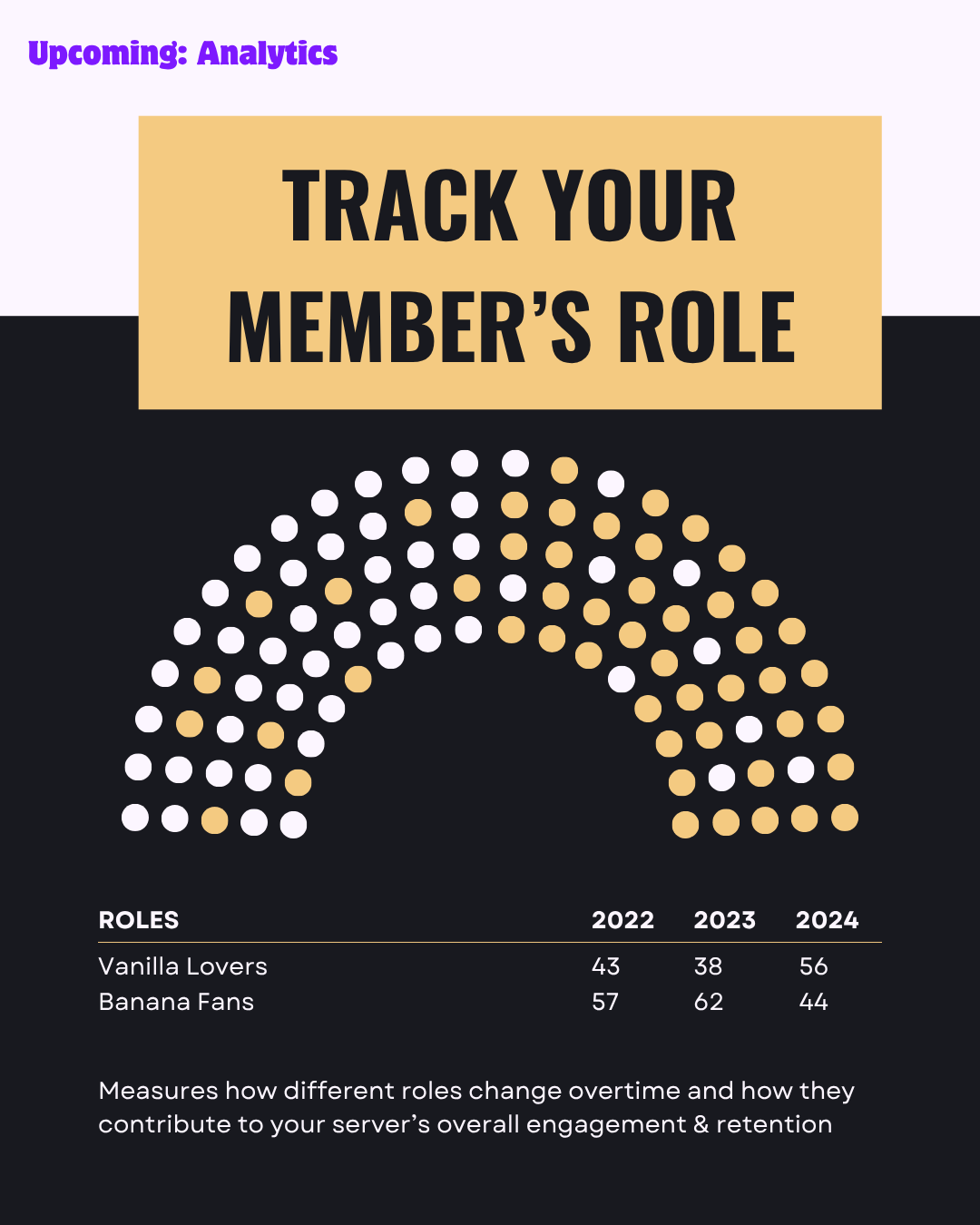
- Analytics that help you measure what’s happening
If your community is particularly “bot-paranoid,” the speaker also mentions other bot tooling (e.g., Bee) as an option.
Growth timeline: plan at least six months, start “lowkey,” then scale
A key strategic point in the transcript is that sustainable growth takes time. The speaker recommends planning for at least six months.
Foundation first (roughly four months), then ramp marketing
The video explains the difference between “hype” and foundation:
- Hype can be bought in web3 and is not hard to create.
- But projects that sell out tend to show more community activity before marketing ramps up.
The speaker frames marketing ramp-up around about 60 days, and suggests that the first four months should be lower-cost “lowkey” community management focused on conversation.
Rushing marketing too early is positioned as one of the worst moves you can make.
Event formats that drive engagement: async, semi-sync, and voice
Not every event requires a large synchronized audience. The transcript distinguishes multiple formats that can work at different community stages.
Async events: low coordination, scalable participation
Async events are described as better earlier because you don’t need many people to show up simultaneously.
The transcript’s examples are simple, participation-based activities where users can earn points without extra coordination (the key idea is that tasks are easy to start and don’t require scheduling).
Semi-sync events: casual voice with moderators present
Semi-sync events blend voice chat and moderation presence:
- Moderators are on voice.
- Later, the conversation can extend into text.
This is framed as creating a “space-like experience” that supports social bonding.
Voice chat is underutilized—but useful for friendships
The video calls voice chat “really totally underutilized.” The rationale is direct: hearing voices helps people form friendships, which increases the likelihood they return.
Quest engine and daily quests: build instant gratification and habits
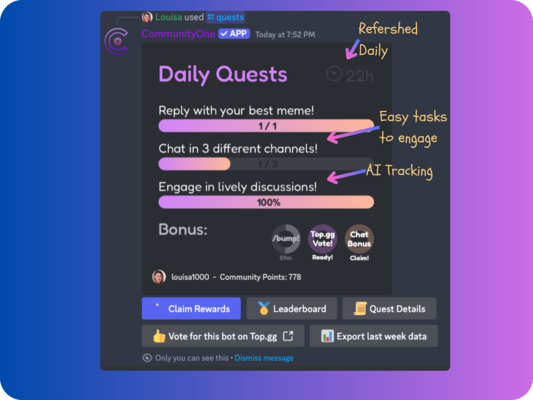
The transcript recommends using a “Quest engine” to create immediate, repeatable engagement.
How the Quest engine works
In the described setup:
- Users type a command to start quests.
- Users see what they can do and earn points/XP.
The emphasis is on instant gratification: there should be something easy to do right away.
Why points alone aren’t the main reason people return
The speaker emphasizes that users return mainly for social reasons—friends and server connections—rather than only for rewards they already earned.
Announcements matter because many users check them first
The transcript states that about 50% of people check announcements first to understand what’s happening and whether the server is actively managed.
That means announcements should be treated as part of onboarding and retention—not just a broadcast channel.
Discord KPIs: track bot rates, chat rate, verification friction, and conversion
The final pillar is measurement. The video repeatedly ties community health to KPI tracking—especially during marketing spikes and launch periods.
Bot/farm rate expectations during growth
The transcript gives a practical benchmark: during aggressive marketing and large collaborations, typically 60–80% of accounts may be bot/farm accounts.
Online-to-total ratio KPI (visibility and quality)
A key metric is the online-to-total user ratio:
- Target around 10%.
- If it’s below ~3%, the transcript suggests adjusting marketing strategies.
New joins vs leaves: detect mismatch early
Track new joins versus leaves to identify confusion or mismatches between what users expected and what the Discord delivers.
Verification friction KPIs
Verification is not just a checkbox—it can change user behavior.
The video describes different verification types (e.g., click-button vs capture-style vs CAPTCHA-like) and suggests friction can reduce verification rates (for example, capture may be much lower on mobile).
The transcript also provides targets/targets-like guidance:
- When verification is hard, fewer users proceed.
- The goal is to measure how many verified users become engaged chatters.
Engagement conversion metrics
The transcript emphasizes:
- Track the percentage of verified users who actually chat (it mentions aiming for roughly 50% of verified).
- Measure “one-message” behavior as a conversion proxy: target under 35% (higher values like ~60% can indicate forced messaging for points or poor responses).
If chat rate is low, the speaker’s action-oriented takeaway is that you must talk to people and train moderators/people to talk.
Time-window habit metrics
Another KPI described is an 8-day window:
- Users should come in at least three days.
- They should send roughly 15+ messages across that window.
This is positioned as a way to detect daily engagement time (roughly 5–10 minutes/day).
Putting it together: the sustainable Discord loop
Based on the transcript’s structure, sustainable Discord growth looks like a loop:
1. Security + permission hygiene (reduce spam and scams early)
2. Mobile-first onboarding (make the purpose obvious within seconds)
3. Moderation + bots (Vic for auto-moderation and analytics)
4. Async quests + announcements (instant gratification and ongoing “what’s next”)
5. Event mix (async and semi-sync first; use voice to build friendships)
6. KPI-driven iteration (bot rate, online ratio, verification friction, chat conversion, and habit metrics)
Conclusion
The video’s core message is that Discord becomes sustainable when it’s treated as a core asset and operated like a measurable system: secure permissions, simple onboarding, consistent moderation, engagement mechanics like async quests, and KPI tracking that catches problems early. If you build for participation—not just audience—you give your community a reason to keep coming back.